What is human resource diversity, and is DEI still legal?
October 5, 2026
Diversity in HR means the range of people a workforce includes and how fairly they are hired, paid and promoted. What changed in 2025, what the EEOC says is illegal, and what…
By McKinley Malbrough III, J.D., MS-HRM
Published November 6, 2026.
Short answer
Inclusive HR is a set of repeatable systems, not a statement: structured hiring, clear pay ranges, accessible scheduling and communication, consistent discipline and a complaint process that works. A small employer can run all five, measure them with simple counts and fix gaps, without a dedicated department and without making promises it cannot keep.
Inclusive HR is a set of repeatable systems, not a statement: structured hiring, clear pay ranges, accessible scheduling and communication, consistent discipline and a complaint process that works. A small employer can run all five, measure them with simple counts and fix gaps, without a dedicated department and without making promises it cannot keep.
I am Mac Malbrough. I hold a J.D. and an MS-HRM, I am not an attorney, and I grew up in the Oakland neighborhoods where many of my clients operate. I work with owners whose teams are mixed in language, background, age and experience, and who want fair systems without a bureaucracy. This is general information, not legal advice, and any example is a hypothetical I wrote.
It means that the rules of the workplace work for the people who are actually in it. A hiring process that asks the same questions of everyone. A pay structure you can explain. A schedule that someone with a long transit commute or a caregiving duty can follow. A policy written in the language people read. A complaint process that a worker will use without fearing for their job.
None of that requires a slogan. It requires a handful of systems that you can inspect. The reason I frame it this way is practical: the businesses I work with do not have a diversity officer, and they should not need one. They need an owner or manager who can look at a system, ask who it works for and who it leaves out, and adjust. The article on human resource diversity covers the vocabulary. This article is about the work.
Three patterns repeat. The first is treating inclusion as an event, such as a training or a month of posts, while the daily systems stay the same. The second is relying on a manager’s good intentions, which vary from person to person and from day to day. The third is not looking, because counting feels risky. Owners worry that data will expose a problem. In my experience, the problem is already there and the data lets you fix it before an outsider finds it.

The fix in each case is the same: replace intentions with systems, and check the systems.
Use a structured process. Write the role outcomes first, ask each candidate the same core questions in the same order and score the answers against the outcomes on a sheet before comparing notes. This reduces the pull of a first impression, a shared background or a “good vibe,” which tend to favor people who look like the interviewer.
Then look at the front door. Does the job post list requirements that the work does not need, such as a degree for a role where experience would do? Should you drop the degree requirement shows how to test it. Does it state the pay range, as California requires of covered employers? The job posting pay range page covers the rule. The structured interview scorecards give you the sheet.
Set a range for every role, place people in it for stated reasons and review the result at least once a year. The reasons should be about the work: skill, scope, experience, performance. When two people in the same job are paid differently and the reason is “that is what they asked for,” you have found a gap to examine. The pay equity check without a PEO shows how to run the review, and the pay equity audit workbook is the tool I use. If the review shows a gap, document the plan to close it and follow through.
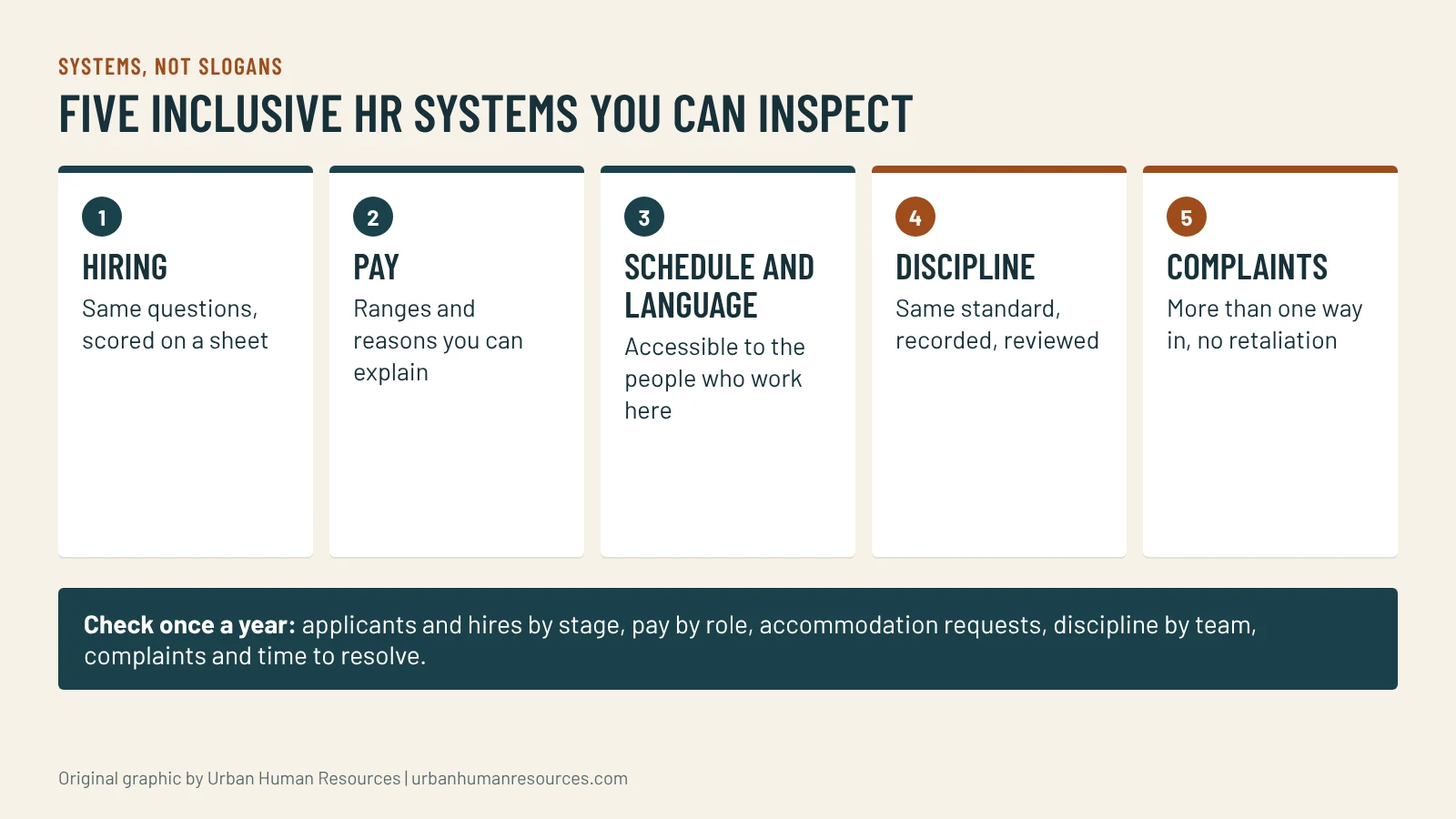
Start with who cannot follow the current system. If half your team reads the schedule in another language, an English-only posting is a barrier, not a policy. California employer language access for a multilingual workforce explains what to translate and when. If employees rely on transit or have caregiving duties, a schedule posted on short notice produces attendance trouble that looks like a performance problem. Attendance and scheduling for transit-dependent employees gives a policy you can adapt.

Accommodation belongs in this system too. Make it easy to ask: name one person who receives requests, tell people that requests are confidential and respond promptly and in writing. A person who has to hunt for the right manager or guess at the process will often not ask at all. For two examples of workplace protections that sit in this area, see menopause workplace protections in California and designated person bereavement leave.
Write the standards, apply them the same way and record what happened. Consistency is both a fairness rule and a legal defense. When two employees break the same rule and get different results, the employer needs a reason that is not about who they are. A short manager playbook and a rule that discipline above a verbal warning gets a second look before it is delivered will catch most of the problem. Use the performance review and PIP templates for the documents and performance improvement plans in California for the process.
Review the pattern once a quarter. Count the verbal warnings, written warnings and terminations by team and by manager. You do not need to dig into protected characteristics to see that one supervisor accounts for most of the discipline. That is a conversation to have with the supervisor.
Give employees more than one way to raise a concern, tell them how, promise no retaliation and then keep the promise. A complaint line that sits with the person the complaint is about is not a line. For a very small team, the owner may be the only option, so name an outside contact, such as a consultant, who can receive concerns too. When a complaint arrives, acknowledge it the same day, decide who will look into it, and tell the person what to expect. California’s 90-day retaliation presumption is a reason to take the timing seriously.
I do not investigate complaints for clients, and I am not an attorney. When a complaint raises a legal question or a possible claim, bring in an employment attorney. What the HR system can do is make sure the complaint reaches the right person quickly, and that the record shows what was done.
Count five things once a year and read the pattern with a careful eye. Applicants and hires by stage, so you can see where candidates drop. Pay position by role and tenure. Requests for accommodation and how long they took. Discipline by team and manager. Complaints received and how long each took to resolve. Keep the data at the group level, restrict access and do not try to infer anything about an individual from it.
When a number looks off, treat it as a question, not a verdict. A gap in pay might reflect real differences in scope. A gap in hiring might reflect where you post. The point is to look, and to be able to explain what you see or change it. The one-page HR dashboard has a place for these counts.
Pick the system where you think the gap is widest and run one check on it. If it is pay, list each person in a role with their pay and the reason for their position in the range. If it is hiring, read your last three job posts for requirements that the work does not need. One check, one afternoon, one fix.
If you want a structured review, the pay equity audit covers system two in depth, and my HR services for small businesses include building and checking all five. The HR compliance check-up is a good first step if you are not sure where to start.
This article gives a method, not statistics. The legal points are covered, with their primary sources, on the pages linked below.
Data current as of November 2026. Sources are linked where each figure appears.
McKinley holds a J.D. but is not a licensed attorney. Articles here are general information, not legal advice. For your specific situation, talk with an employment attorney.
Share this article
This article is general information, not legal advice. Laws change and every situation is different; for advice on yours, talk with an employment attorney.
Related questions
October 5, 2026
Diversity in HR means the range of people a workforce includes and how fairly they are hired, paid and promoted. What changed in 2025, what the EEOC says is illegal, and what…
October 25, 2026
Wage notices, safety training and harassment policies may need to be in the language your employees use. What California requires for each, what to translate first, and why machine translation alone is…
October 29, 2026
A California small business owner can review pay by sex, race and ethnicity in an afternoon with a spreadsheet. The law behind it, the steps I use and the point where a…