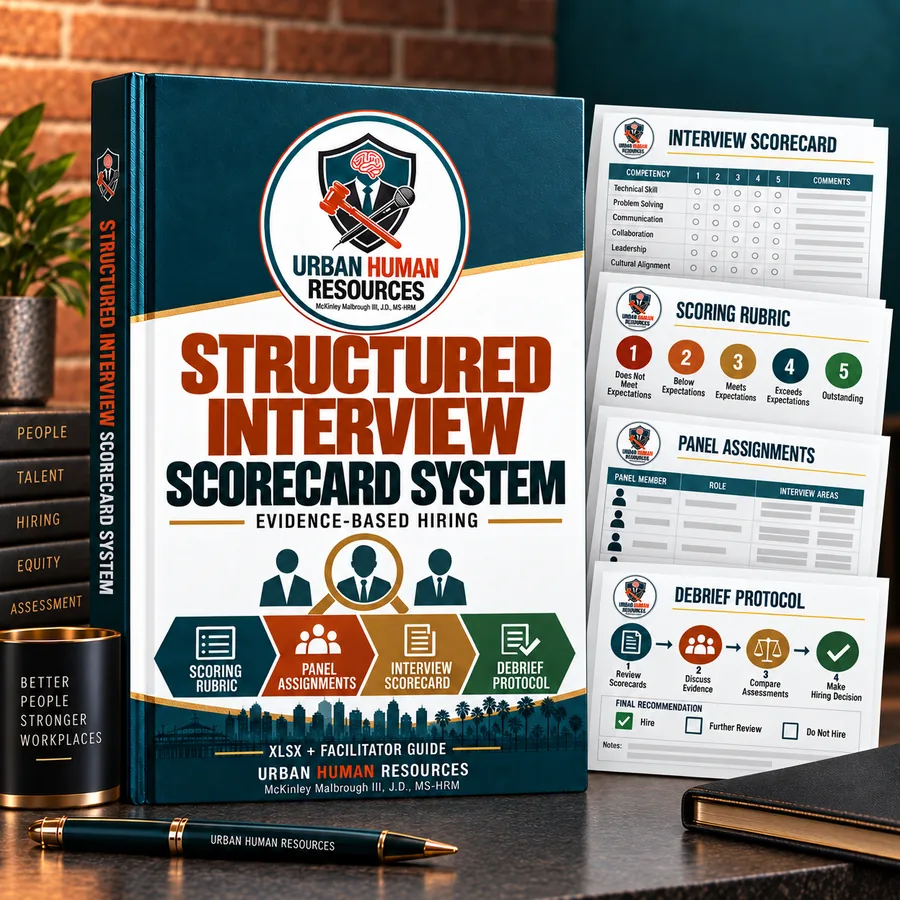
Structured interview scorecard system
Scoring rubrics, panel assignment grids and the debrief protocol that stops hiring decisions turning…
$79 · See it
By McKinley Malbrough III, J.D., MS-HRM
Posted October 5, 2026.
Short answer
Yes, for most roles that do not legally require a credential, but deleting the line from the job post is not enough. A Harvard Business School and Burning Glass Institute study of 11,300 roles found that removing degree requirements changed fewer than 1 in 700 hires, because most employers kept screening and interviewing the same way. The firms that changed how they evaluated skills hired more people without degrees, and those hires stayed longer.
Over the last decade, a long list of large employers announced they were dropping the bachelor’s degree from job requirements. It was good news for the majority of American workers who do not hold one, including a lot of first-generation professionals I work with who learned the job by doing it. Then researchers checked what actually happened.
Much less than the announcements promised. Harvard Business School’s Project on Managing the Future of Work and the Burning Glass Institute studied 11,300 roles at large firms before and after the requirement came off. The increase in actual opportunity added up to fewer than 1 in 700 hires in a year.
The firms split into three groups. About 45% made a change in name only: the posting changed, the hiring did not. About one in five made short-term gains and then slid back. The remaining 37%, which the researchers call Skills-Based Hiring Leaders, increased their share of hires without a bachelor’s degree by nearly 20%, and those hires had retention rates 10 percentage points higher than their degree-holding colleagues (HRD summary).
Because the degree was never only in the job post. It was in the resume screen, in the applicant tracking system’s filters, in which candidates a recruiter called back, and in what interviewers treated as a signal of competence. Remove it from one place and the other four keep doing its job. If you want to see how much of that happens before a person reads anything, how applicant tracking systems screen candidates walks through it.

Changing what you evaluate, not just what you post. For a small business, that means four moves:

The full process, from intake to offer, is in how to build a recruiting process that gets offers accepted.
When the work legally or practically requires a credential: licensed professions, roles that need a specific body of knowledge you cannot test in an interview, or positions where a client contract demands it. Everywhere else, ask the hiring manager which skill the degree is standing in for, then hire for that skill directly.
For employers, the payoff is a bigger pool and, if the Burning Glass numbers hold, people who stay. For candidates without degrees, the takeaway is to apply on evidence: lead your resume with results, not education, and let the work make the case. If you are building either side of that, my structured interview scorecards give employers the evaluation tool, and the career coaching work helps candidates present the proof.
McKinley holds a J.D. but is not a licensed attorney. Articles here are general information, not legal advice. For your specific situation, talk with an employment attorney.
From the store
Structured interview scorecard system
Scoring rubrics, panel assignment grids and the debrief protocol that stops hiring decisions turning…
$79 · See it
This post is my view, written as general information. It is not legal advice.
More from the blog
Blog · October 7, 2026
Otter, Fireflies, Read.ai, Zoom AI Companion, Copilot in Teams and Gemini in Google Meet can all record and summarize a meeting, some without anyone asking. California requires every participant's consent, the Otter.ai…
Blog · October 6, 2026
Your employer is moving from California to Austin and wants an answer. What you gain and give up under Texas employment law, how to negotiate a relocation package now that it is…
Blog · October 5, 2026
Yes, from your first employee. But a checklist you fill out once goes stale by January. What has to happen every year, at every hire, and what changed for 2026.
Want the researched version? Browse every article.