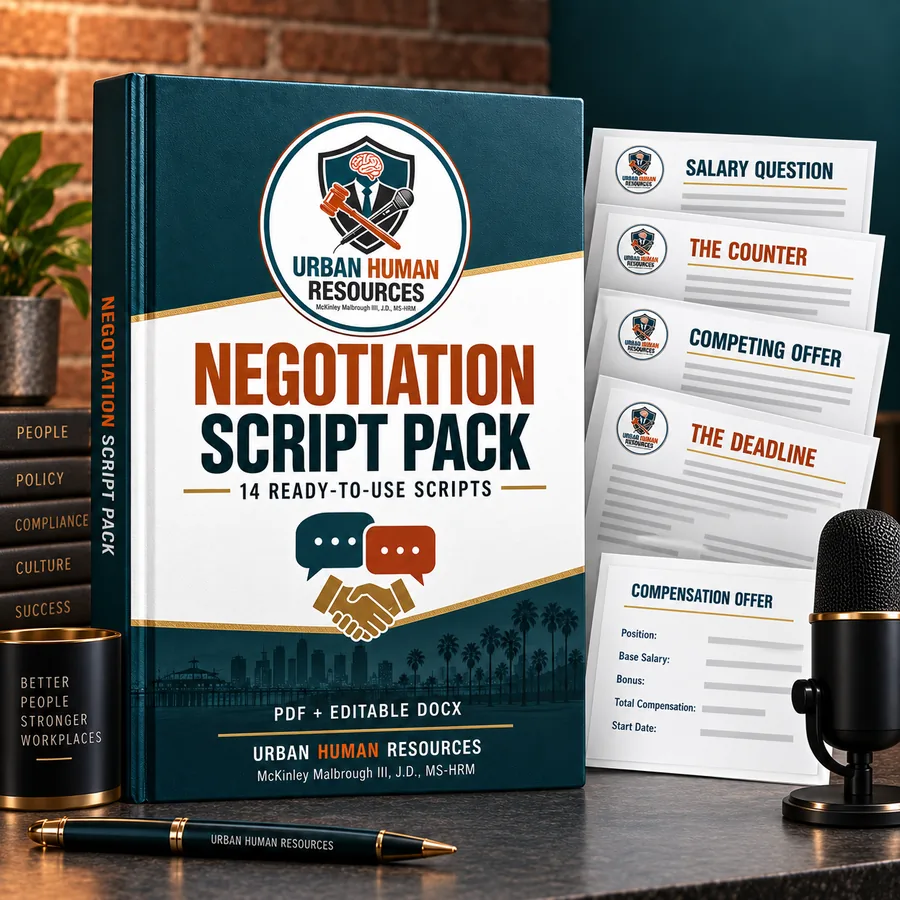
Word-for-word language for the salary question, the counter, the competing offer and the deadline:…
$49 · See it
First-Generation Professionals
By McKinley Malbrough III, J.D., MS-HRM
Published September 19, 2026. Last updated September 25, 2026.
Short answer
The anomaly trap is what happens when a system built on averages treats a person who does not match those averages as an error. AI tools and hiring filters both do it. You get around it by telling the system who you are, checking its claims against sources, and putting a person between you and the filter.
I grew up in East Oakland, ZIP code 94603. According to the U.S. Census Bureau’s American Community Survey for 2020 to 2024, 31.6% of adults 25 and older there have no high school diploma, 14.7% hold a bachelor’s degree or higher, and about 3 in 1,000 hold a professional degree like a J.D.
Across California, fewer than 2 in 100 HR professionals hold a professional degree, based on the Census Bureau’s 2023 American Community Survey microdata. By the averages, someone from 94603 does not finish a professional degree or build a career in HR. I did both. I named the anomaly trap because I kept running into systems that were sure I could not exist.
An AI model answers from the patterns in what it was trained on. When it knows nothing about you, you get the default answer, written for the average person. When it infers who you are from indirect clues, such as a name, a school, or a ZIP code, it can price you by the averages of where you come from.
The same logic shows up in people. Economists at Boston University showed how employers can end up monitoring Black workers more closely than white workers, so the same mistake is caught and punished more often, even when the groups are equally productive (Cavounidis and Lang, NBER Working Paper 21612, 2015). California now regulates automated decision systems used in employment under FEHA, effective October 1, 2025, because the pattern is real.
People do it too. Being asked to sound, dress or present like the average hire is the everyday version, and code-switching has a measurable cost.
If your organization uses software to screen, rank or score candidates, California’s rules treat that output like any other employment decision. Keep the records, test the results by group, and make sure a person with authority can overrule the tool. The full breakdown of how I test AI in HR work is on the AI and HR page.
Nobody was ever going to tell you how it works, so I did; now pass it on. The averages were wrong about me, and they are wrong about you. I use AI to compact the time. The thinking, and the read on you, stay with a person who knows where the system breaks.
McKinley holds a J.D. but is not a licensed attorney. Articles here are general information, not legal advice. For your specific situation, talk with an employment attorney.
Data current as of September 2026. Sources are linked where each figure appears.
From the store
Word-for-word language for the salary question, the counter, the competing offer and the deadline:…
$49 · See it
This article is general information, not legal advice. Laws change and every situation is different; for advice on yours, talk with an employment attorney.
Related questions
First-Generation Professionals
April 4, 2026
Code-switching is adjusting how you talk, look and act to fit a workplace norm. It can help careers and it drains energy. Here is the research and what to do.
First-Generation Professionals
September 22, 2026
Research shows biased evaluators penalize Black candidates who negotiate. The answer is to negotiate with data, fewer rounds and everything in writing.
First-Generation Professionals
April 4, 2026
Start with second-degree connections, ask one specific question, and follow up with what you did. Here is the message, the list, and the math.