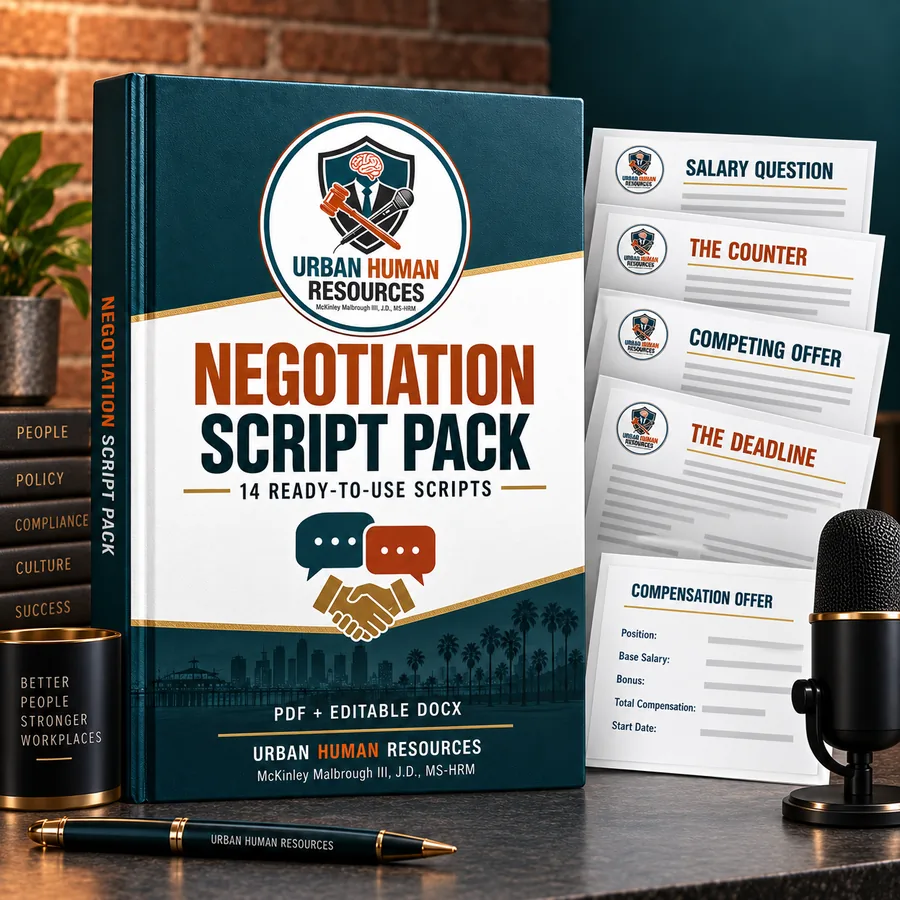
Word-for-word language for the salary question, the counter, the competing offer and the deadline:…
$49 · See it
First-Generation Professionals
By McKinley Malbrough III, J.D., MS-HRM
Published September 22, 2026. Last updated September 25, 2026.
Short answer
Research says the risk is real but specific. In a 2019 study in the Journal of Applied Psychology, evaluators with more racial bias expected Black candidates to negotiate less, perceived them as negotiating more when they negotiated the same amount, and gave them lower salaries as a result. The fix is not to skip negotiating. It is to negotiate with sourced numbers, fewer rounds, and every term confirmed in writing.
In “Bargaining While Black” (Hernandez, Avery, Volpone and Kaiser, Journal of Applied Psychology, 2019), researchers ran three studies on race and salary negotiation.
The penalty is not for negotiating. It is for how much negotiating a biased evaluator thinks they saw. That points to the fix.
A $300 penalty per perceived counter is real money. Skipping the negotiation costs far more. A $10,000 gap at the start compounds through every raise, and over a career it runs to about $269,000. Here is the math. The question is not whether to negotiate. It is how to negotiate so there is less for bias to work with.
1. Get the range first. In California, any employer must give an applicant the pay scale on request, and employers with 15 or more employees must post it (Labor Code 432.3). A number the employer put in writing is harder to call aggressive when you ask to land inside it. Here is how to ask.
2. Make one well-built counter, not five small ones. The study measured the cost of each perceived additional counter. Put salary, sign-on, start date and title into one written counter with a reason for each, so the negotiation takes one round instead of several.
3. Lead with the source, not the want. “Posted ranges for this role and level in the Bay Area run $X to $Y, and my record puts me in the upper half” frames the ask as market data. Evaluators resist concessions less when the number is plainly someone else’s.
4. Put it in writing. Email carries the ask without tone. It also creates a record, which matters if pay is ever questioned later. Recap every phone conversation in a short email the same day.
5. Know your walk-away number before the call. A clear floor keeps you from trading down under pressure, and it keeps the conversation short.
“Thank you for the offer. I’m excited about the role and want to make this work. Based on posted ranges for this role and level in the Bay Area, and the results I’ve delivered in similar work, I’m asking for a base of $X, a $Y sign-on bonus, and a start date of Z. If we can get there, I’m ready to sign this week.” Every term is on the table at once, the source comes first, and the close tells them what agreement looks like.
Do not shrink the ask to seem agreeable. The research shows the penalty comes from the evaluator’s perception, not from the size of a reasonable, sourced request. Lowering your number only guarantees the loss. The same goes for tone: code-switching has its own cost, and you should not have to perform a different person to be paid correctly.
If your offers vary by who pushes hardest, your pay structure is carrying bias you did not intend. Posted ranges, a written approval path for offers outside the range, and a periodic pay equity review close the gap for everyone. California’s Equal Pay Act covers race and ethnicity, not only sex.
McKinley holds a J.D. but is not a licensed attorney. Articles here are general information, not legal advice. For your specific situation, talk with an employment attorney.
Data current as of September 2026. Sources are linked where each figure appears.
From the store
Word-for-word language for the salary question, the counter, the competing offer and the deadline:…
$49 · See it
This article is general information, not legal advice. Laws change and every situation is different; for advice on yours, talk with an employment attorney.
Related questions
First-Generation Professionals
September 15, 2026
Ask for the pay range first. California law entitles you to it, bars salary history questions, and gives you the strongest opening move in the negotiation.
First-Generation Professionals
September 16, 2026
About $269,000 over twenty years on a $10,000 gap. Every raise is a percentage of your base, so the first number is the one that compounds.
First-Generation Professionals
April 4, 2026
Code-switching is adjusting how you talk, look and act to fit a workplace norm. It can help careers and it drains energy. Here is the research and what to do.