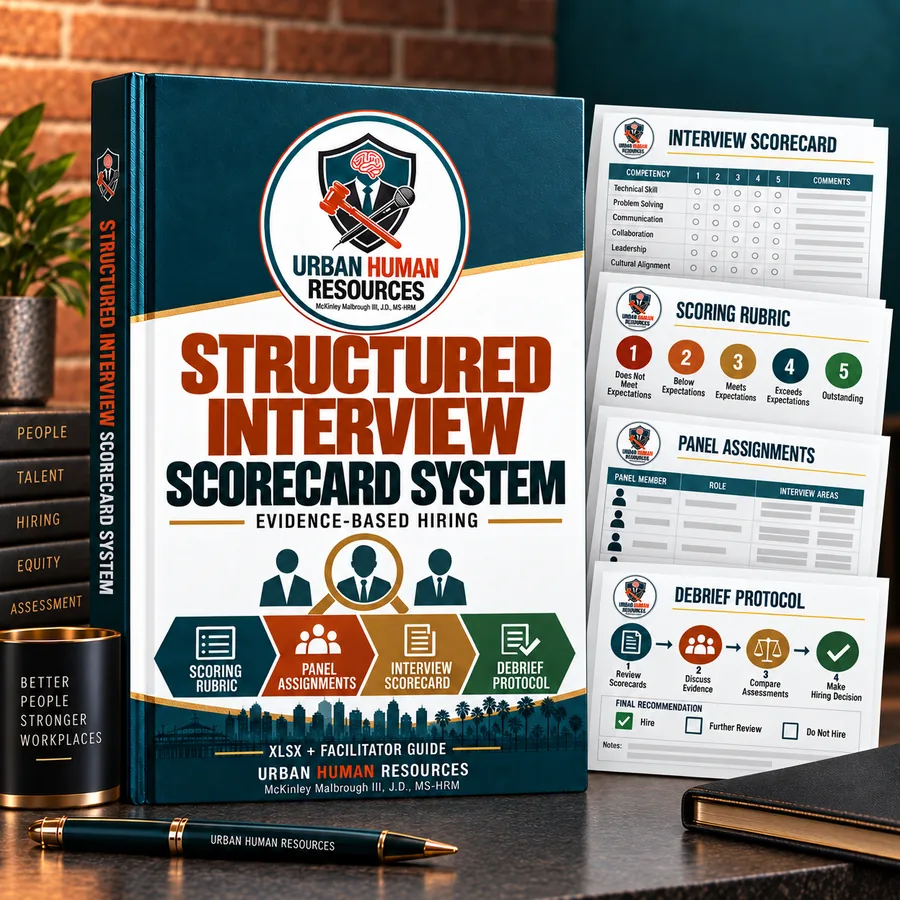
Structured interview scorecard system
Scoring rubrics, panel assignment grids and the debrief protocol that stops hiring decisions turning…
$79 · See it
By McKinley Malbrough III, J.D., MS-HRM
Published October 1, 2026.
Short answer
Source from at least two channels so referrals never become your only pipeline, then score every candidate on the same job-related questions. In the research, structured interviews are the strongest single predictor of job performance, with validity around .42 against about .19 for an unstructured conversation. Referrals stay longer but tend to mirror your current team; candidates you don’t know widen the pool but take more screening. In California, post the pay range once you have 15 employees, and hold criminal history questions until after a conditional offer once you have 5.
A bad hire is expensive in a way that rarely shows up on one invoice. Gallup estimates that replacing an employee costs one-half to two times that person’s annual salary, once you count recruiting, onboarding, lost output and the team’s time. For a small business, that is the real employee turnover cost, and most of it is decided before the first day: by where you looked, what you asked and what you checked.
This is the recruiting and hiring process I set up for small employers and startups in the Bay Area, in the order you should build it.
Start with the job, not the job board. Write a job description that names the three or four outcomes the person must deliver in the first year, the skills those outcomes require, and the pay range. Everything later in the process, from the posting to the interview questions to the scorecard, comes from that document. If you skip it, you will end up comparing candidates on likability.
Then use at least two sourcing channels, so no single channel decides who you see:
Referrals have real evidence behind them. A study of nine large firms across call centers, trucking and high tech, published in the Quarterly Journal of Economics, found that referred workers were 10% to 30% less likely to quit, and that the profit difference came from lower turnover and lower recruiting costs.

The advantages:
The disadvantages are just as real:
The fix is not to stop taking referrals. It is to keep them as one channel, run referred candidates through the same structured interview as everyone else, and pay referral bonuses only when the hire stays past a set period.
Applicants with no connection to your team are where most new perspectives come from.
The costs:
Vetting is about confirming the evidence, not collecting impressions. In order:
If you use AI or other automated tools to screen applications, California’s civil rights regulations have applied to those systems since October 1, 2025. Your business can be liable for what the tool does, so test it before you trust it. More on that on the AI page.
Run structured interviews: the same job-related questions, in the same order, scored on the same scale by each interviewer independently. In the largest recent re-analysis of hiring research, structured interviews had the highest average validity of any method studied, about .42, while unstructured interviews came in around .19. A friendly conversation tells you whom you liked. A structured interview tells you who can do the job.

What to look for in the answers:
Score each answer on a written 1 to 5 scale with an anchor for what a 1, 3 and 5 look like, before the interviewers compare notes. Talking first lets the most senior person’s view become everyone’s view. My structured interview scorecards are ready-made HR templates for this.
Several California hiring rules apply long before a business thinks of itself as needing HR:
The full list, threshold by threshold, is in California HR laws by headcount.
The hire is the start of employee retention, not the end of recruiting. The scorecard becomes the first 90-day goals, the work sample shows where onboarding should focus, and the pay range you posted becomes the band you manage to. For HR for small business owners, that connection is usually the gap: the hiring decision is made carefully and then never written down.
If you are making your first HR hire, or hiring often enough that it has become a second job, an outsourced HR partner can build this process once and hand it to you. I do this work as an HR consultant in the Bay Area, and you can book a free consultation to walk through your next opening.
McKinley holds a J.D. but is not a licensed attorney. Articles here are general information, not legal advice. For your specific situation, talk with an employment attorney.
Data current as of September 2026. Sources are linked where each figure appears.
From the store
Structured interview scorecard system
Scoring rubrics, panel assignment grids and the debrief protocol that stops hiring decisions turning…
$79 · See it
This article is general information, not legal advice. Laws change and every situation is different; for advice on yours, talk with an employment attorney.
Related questions
September 13, 2026
Price the job before the person: define the level, pull three market sources, set the midpoint, and check it against the people you already pay.
September 11, 2026
The HR requirements for small businesses in California, by headcount. At 5 employees most discrimination, leave and training rules begin; at 15, pay ranges in postings; at 100, pay data reporting. The…
September 28, 2026
A PEO runs payroll and benefits, fractional HR brings senior judgment part time, and a first HR hire costs $140,000 or more loaded. The math at 25 employees.