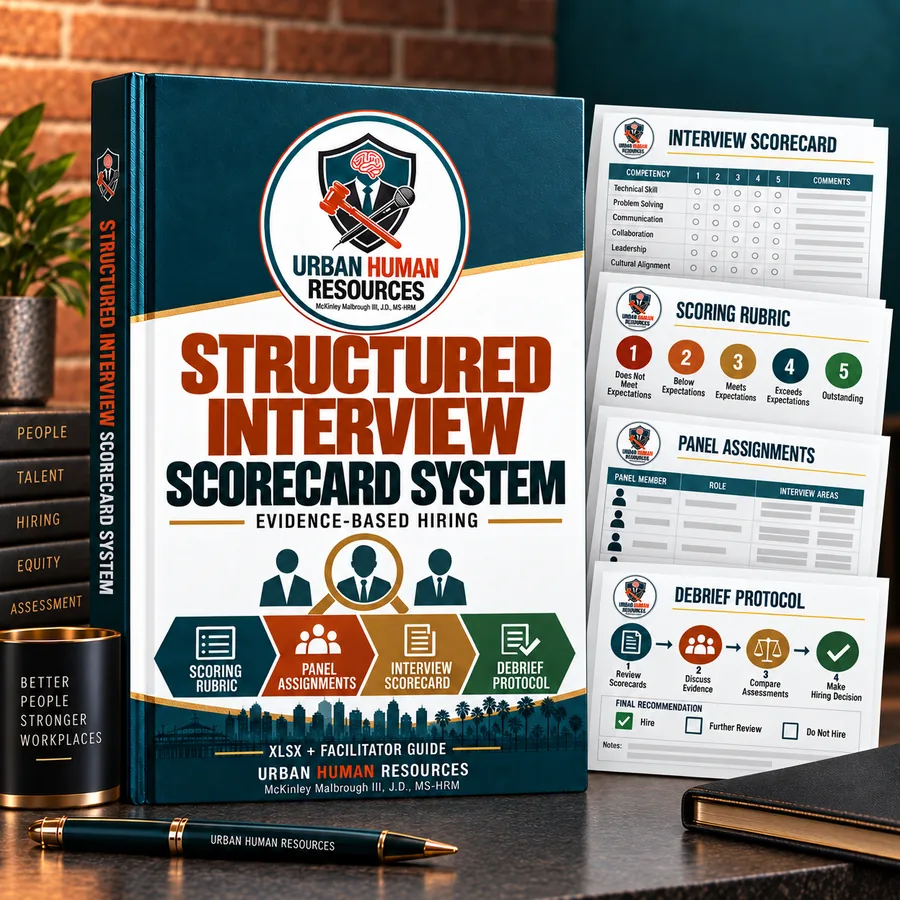
Structured interview scorecard system
Scoring rubrics, panel assignment grids and the debrief protocol that stops hiring decisions turning…
$79 · See it
By McKinley Malbrough III, J.D., MS-HRM
Published October 5, 2026.
Short answer
A recruiting process that gets offers accepted has five parts: an intake meeting that defines the outcomes the role must produce, a job post built on a short list of real requirements and a pay range, a schedule that moves a candidate from application to offer in about three weeks, a close that confirms the terms verbally before the written offer goes out, and a quality-of-hire check at 90 days. Most small businesses skip the first and last steps, which is why the same roles keep reopening.
When a small business tells me it can’t find good people, the problem is rarely the market. It is usually the process: a role nobody defined before posting it, a job ad copied from the last person who held it, three weeks of silence between interviews, and an offer the candidate learns about for the first time in writing. Good candidates leave every one of those gaps for a company that moves with intent.
This guide covers the recruiting process from the intake meeting to the signed offer. Where to find candidates and how to interview them is covered in how to source, interview and vet candidates; this is the system those steps plug into.
The benchmark is sobering. SHRM’s 2025 recruiting benchmarking of 2,371 organizations put median time-to-fill at about a month and a half, 44 days for nonexecutive roles, and 69% of organizations report difficulty filling full-time positions. Median cost-per-hire for nonexecutive roles was $1,200, but that figure counts ads, fees and recruiter time. It does not count the cost of an empty seat or the cost of hiring the wrong person.
A process that closes runs in five stages, each with an owner and a deadline:
Start with an intake meeting, 30 minutes, before a single word of the job post is written. The hiring manager answers four questions:

The first question does the most work. “Owns accounts payable” is a duty. “Closes the books by the fifth business day with no late vendor payments” is an outcome, and outcomes are what you can screen and interview for. Set the pay range now, using how to set a pay range for a new role, because a range approved after interviews start becomes a range that loses the candidate.
Fewer requirements and a visible number. LinkedIn’s analysis of its members’ job search behavior found women apply to 20% fewer jobs than men but are 16% more likely to be hired once they apply. A post padded with nice-to-haves screens out qualified people before you ever see them, and the LinkedIn data suggests it screens out women first.
Faster than you think, and on a schedule the candidate can see. Aim for three weeks from application to offer for most roles: screening calls within five business days of the post closing, all interviews inside one week, and a decision within two business days of the last interview. Put the interview dates on calendars during intake, before the post goes live.

Silence is the most common way small businesses lose candidates. In Greenhouse’s data, only 4% of roughly 6,500 companies contacted every rejected applicant, and 61% of job seekers report being ghosted after an interview. Candidates remember, and they talk to people who do the same work. Two rules fix most of it: tell every interviewed candidate where they stand within two business days of each step, and close every application with a decision, even a short no.
Never let the written offer be a surprise. Before anything goes out, the hiring manager or the person running the search calls the finalist and confirms the essentials: start date, base pay, bonus or equity, benefits, remote or on-site expectations, and anything the candidate raised during interviews. Ask directly, “If we put this in writing, are you ready to accept?” A hesitation now is a negotiation you can still have; a hesitation after the letter goes out is often a decline.
The offer is also where pay structure shows. If offers routinely move outside the range for whoever pushes hardest, that pattern is a pay equity problem waiting to surface; a written approval path for exceptions prevents it.
Measure quality of hire, not just speed. SHRM found only 20% of organizations track it, down from 27% in 2022, which means most companies cannot tell whether a fast hire was a good one. A small business can track it with four numbers per hire:
Review those numbers by source, too. If referrals keep producing hires who stay, invest in them; if one job board produces volume but no 90-day successes, stop paying for it. The structured interview scorecards give you the interview data to connect to these outcomes.
If your roles keep reopening or offers keep falling through, the fix is usually one stage of the process, not all of it. A compliance check-up covers the California hiring rules, and my HR services for small businesses include building the full recruiting process with your hiring managers.
McKinley holds a J.D. but is not a licensed attorney. Articles here are general information, not legal advice. For your specific situation, talk with an employment attorney.
Data current as of September 2026. Sources are linked where each figure appears.
From the store
Structured interview scorecard system
Scoring rubrics, panel assignment grids and the debrief protocol that stops hiring decisions turning…
$79 · See it
This article is general information, not legal advice. Laws change and every situation is different; for advice on yours, talk with an employment attorney.
Related questions
October 1, 2026
Use at least two sourcing channels, score every candidate on the same job-related questions, and know where referrals help and where they quietly narrow your pool.
September 13, 2026
Price the job before the person: define the level, pull three market sources, set the midpoint, and check it against the people you already pay.
October 2, 2026
No law requires an HR department. California still hands you HR duties with your first employee. What small businesses actually need at each size, what can be outsourced and what it costs.