California employee handbook template
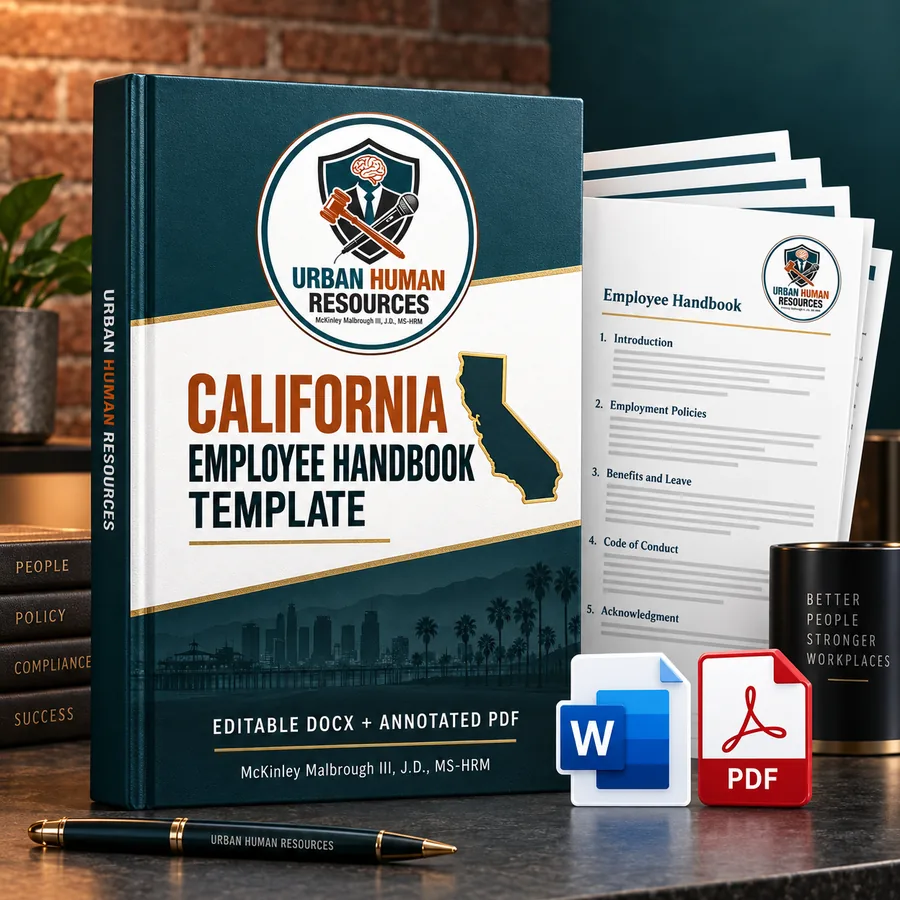
A full handbook in editable form, with the California-specific clauses written out and annotated…
$149 · See it
By McKinley Malbrough III, J.D., MS-HRM
Published September 22, 2026. Last updated September 26, 2026.
Short answer
A California HR compliance check-up for a 10-to-50-person company reviews seven areas: worker classification, pay practices and wage statements, job postings and pay scales, leave policies, required training, written safety plans, and personnel and I-9 files. It measures each against the rules that apply at your headcount and ends with a ranked list of fixes, starting with the ones that carry penalties.
Between 10 and 50 employees, a company crosses most of California’s employment thresholds while HR is still a side job for a founder, an office manager or an operations lead. At 5 employees, the full FEHA discrimination rules, CFRA leave and harassment prevention training begin. At 15, pay scales must appear in every job posting. The headcount hub lists every line. A check-up confirms that your paperwork crossed each line when your headcount did.
Every contractor gets tested against the ABC test, and every salaried employee gets tested against the exempt duties and salary rules. Misclassification is the most expensive single finding in most small-company reviews, because it reaches back into overtime, meal and rest breaks, expense reimbursement and wage statements at once.
Two pay practices carry the largest penalties: final pay on time and meal and rest break premiums, which PAGA can multiply across a whole staff.
At 15 employees, every job posting needs a good-faith pay scale, and you must keep title and wage history records. Under 15, you still owe the range to any applicant who asks. Here is what small employers owe. The check-up also confirms the required state and federal workplace notices are posted where employees see them, including remote employees.
The handbook should match current law: CFRA, pregnancy disability leave, bereavement leave, reproductive loss leave, paid sick leave and any Bay Area city rules that go further (how the main three fit together). Outdated leave language is one of the most common findings, because the rules change almost every January.
At 5 employees, harassment prevention training is due every two years: two hours for supervisors, one hour for everyone else, and within six months of hire or promotion. The check-up confirms who was trained, when, and that you kept the records. Here is how the training works for small employers.
I-9s kept separately from personnel files, completed on time and retained correctly. Personnel files and payroll records that an employee can inspect on request within the legal deadlines. Offer letters, handbook acknowledgments and policy sign-offs on file for everyone.
For a company of 10 to 50 people, the document review takes about a week once the files are in hand: handbook, offer letters, a recent payroll register, a sample of wage statements, job postings, the contractor list and training records. A working session then walks through the findings with whoever owns HR, so the fixes have a named owner before the meeting ends. Nothing in the review requires you to stop hiring or change systems first.
A ranked list, not a binder. Items that carry penalties or back pay go first. Items that only need a policy update go last. Each item names the fix, the owner and the deadline. If the list is long and nobody on staff owns HR, that is the point to look at what fractional HR costs against the cost of the findings.
McKinley holds a J.D. but is not a licensed attorney. Articles here are general information, not legal advice. For your specific situation, talk with an employment attorney.
Data current as of September 2026. Sources are linked where each figure appears.
From the store
California employee handbook template
A full handbook in editable form, with the California-specific clauses written out and annotated…
$149 · See it
This article is general information, not legal advice. Laws change and every situation is different; for advice on yours, talk with an employment attorney.
Related questions
September 18, 2026
At 5 employees most discrimination, leave and training rules begin; at 15, pay ranges in postings; at 100, pay data reporting. The full list by threshold.
September 17, 2026
In California the worker is an employee unless you can prove all three parts of the ABC test. Part B is where most small organizations fail.
September 22, 2026
California requires harassment training at 5 employees. A qualified trainer, interactive e-learning or the state's free course can meet it. How to choose.