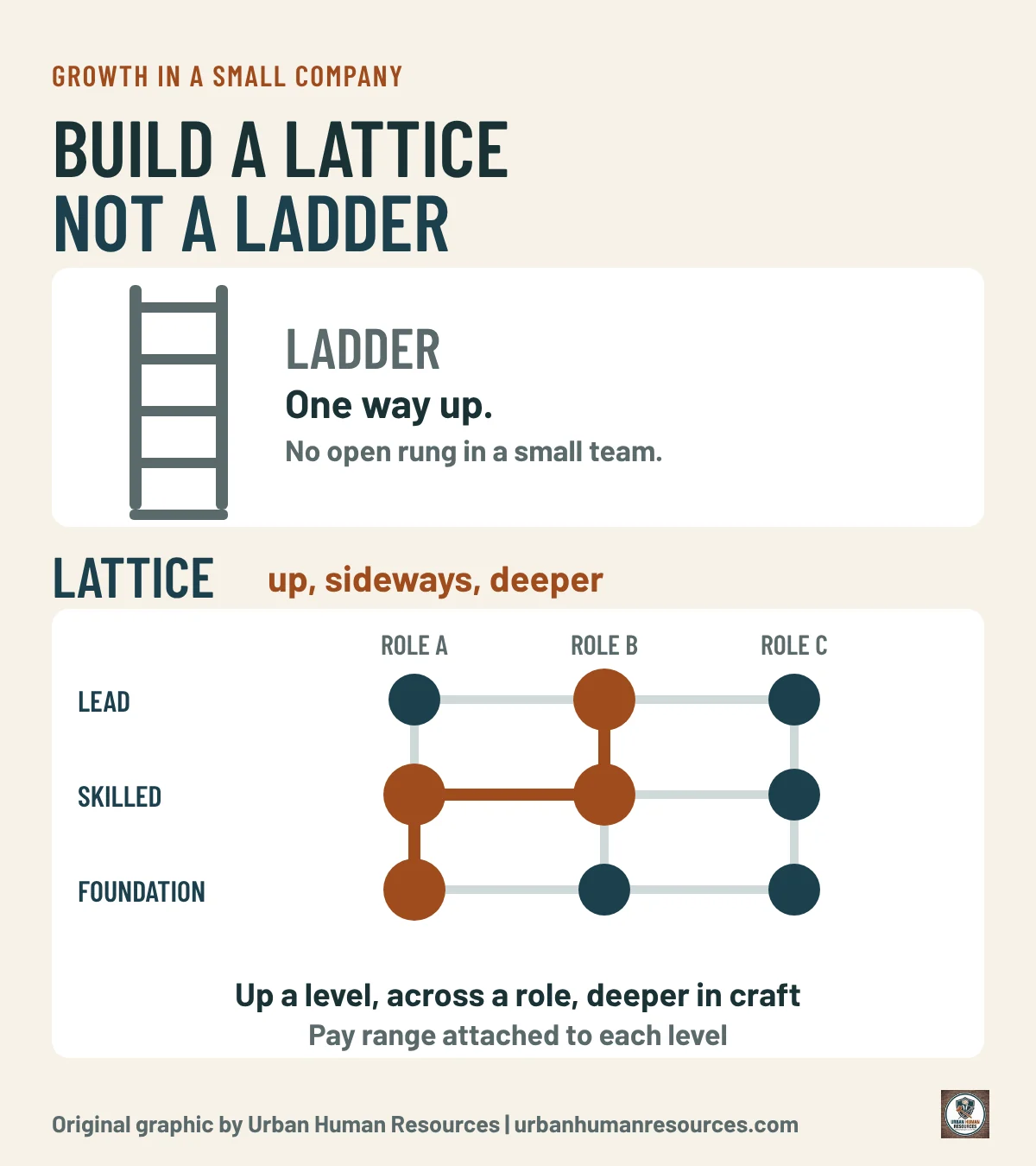
A small company cannot add layers, so offer growth through a lattice: three skill levels in each role, planned lateral moves and stretch assignments. Define what each level looks like in behavior, attach a pay range to each, and hold a career conversation twice a year. Check pay transparency and equal pay rules before you announce it. An HR advisor can build the levels and ranges with you so growth is not a promise you cannot keep.
A small company cannot add layers, so offer growth through a lattice: three skill levels in each role, planned lateral moves and stretch assignments. Define what each level looks like in behavior, attach a pay range to each, and hold a career conversation twice a year. Check the pay transparency and equal pay rules before you announce it. If your strongest people are leaving because the next title does not exist, an HR advisor can build the levels and ranges with you, so growth becomes something you can actually offer.
I am Mac Malbrough. I hold a J.D. and an MS-HRM, I am not an attorney, and I help small employers build growth paths that fit their size. This is general information, not legal advice, and the examples are hypotheticals.
Why do good people leave when there is no next title?
A fifteen-person company has an owner, a few managers and everyone else. There is no senior level above the senior level. A strong employee looks up, sees that the only opening is a manager’s chair that is not going to open, and starts looking elsewhere.
The usual response is to invent titles, and it fails because a title without pay, scope or authority is a label. People notice within a month. The better response is to stop treating growth as vertical only.
What is a career lattice?
A ladder has one direction. A lattice has several: up, sideways and deeper. Someone can grow by getting better at their craft inside the same role, by moving to a neighboring function to build range, or by taking a defined stretch assignment for a quarter. All of those count as growth, and all of them can be named, planned and paid for within a small company.
Original graphic by Urban Human Resources.
How do you build the levels?
Start with each role and write three levels: foundation, skilled and lead. For each level, write four to six sentences of observable behavior, not adjectives. A foundation customer success associate follows the playbook and escalates when stuck. A skilled associate resolves most issues alone and updates the playbook. A lead associate coaches others and spots patterns before they become complaints.
Keep the levels about what the person does, not how long they have been there. Tenure is a poor proxy for skill, and a tenure rule makes the lattice look like a seniority queue.
How do lateral moves and stretch assignments work?
Lateral moves are planned, not accidental. Pick two or three pairs of neighboring roles where a cross-over makes sense, such as operations and customer support, or bookkeeping and HR administration. A person on a move spends a defined period, often a quarter, learning the neighbor’s work, with a named sponsor and a clear question the move should answer.
Stretch assignments are smaller. A skilled person leads a project, trains a new hire or owns a client relationship for a set period. The assignment has a start, an end and a debrief, which keeps it from becoming unpaid extra work. For the broader picture of structure, see my guide to org structure shapes for small employers.
What pay rules apply before you announce it?
A lattice puts pay in the conversation, so the rules matter. California’s equal pay law, Labor Code Section 1197.5, bars paying employees differently for substantially similar work based on sex, race or ethnicity unless a legitimate factor explains the difference. Define your levels by skill and responsibility, document the reason someone sits at a level, and review it every year. My post on a pay equity check without a PEO shows the review.
Pay transparency applies too. Labor Code Section 432.3 requires an employer, on request, to give a current employee the pay scale for the position they hold, and employers with 15 or more employees must post pay scales in job listings. A lattice with a range for each level makes both easy to answer. My guide on how to set a pay range for a new role covers the ranges.
What does a career conversation sound like?
Twice a year, set aside thirty minutes for each person and ask four questions. What part of your work gives you energy? What would you like to be better at in the next six months? Which neighboring work are you curious about? What would make you want to stay for two more years? Then listen. The point of the first meeting is to learn, not to promise.
Write down what you heard and send a short summary, with one action for you and one for them. A lattice only works if the conversation leads to something the employee can see, even if it is small.
What if there is no budget for raises?
A lattice is not a substitute for pay, and employees know the difference. If you cannot move pay this year, say so, and offer growth that costs time, not money: a stretch assignment, a lateral move, a conference session or a mentor inside or outside the company. Be clear about when pay will be reviewed and what the criteria are. People tolerate a slow raise far better than a vague one.
If you do move someone up a level, move the pay range with them, and write down why. That small record is your protection under the equal pay rules and your proof to the next person that the system is real.
Where does an HR advisor fit?
An advisor helps with the parts that are hardest to do alone: writing level descriptions that managers read the same way, setting ranges that stay consistent across roles and running the first round of career conversations. In my fractional HR and advisory work I build the lattice with you, and I train managers to use it. The first conversation is a free consult.
McKinley holds a J.D. but is not a licensed attorney. Articles here are general information, not legal advice. For your specific situation, talk with an employment attorney.
Your people want to be seen and you are too busy to notice out loud. A ten-minute weekly routine, four tests for praise that lands, three traps, and the pay and tax…
If one person holds payroll, benefits renewals and the I-9s in their head, a resignation or a sick week becomes a legal deadline. A five-column task inventory, the three-week test, a documentation…
Small employers pile up HR tools and renew them on autopilot. A one-afternoon audit lists every tool, owner, seat and renewal date, flags overlap and unused seats, and adds a vendor question…