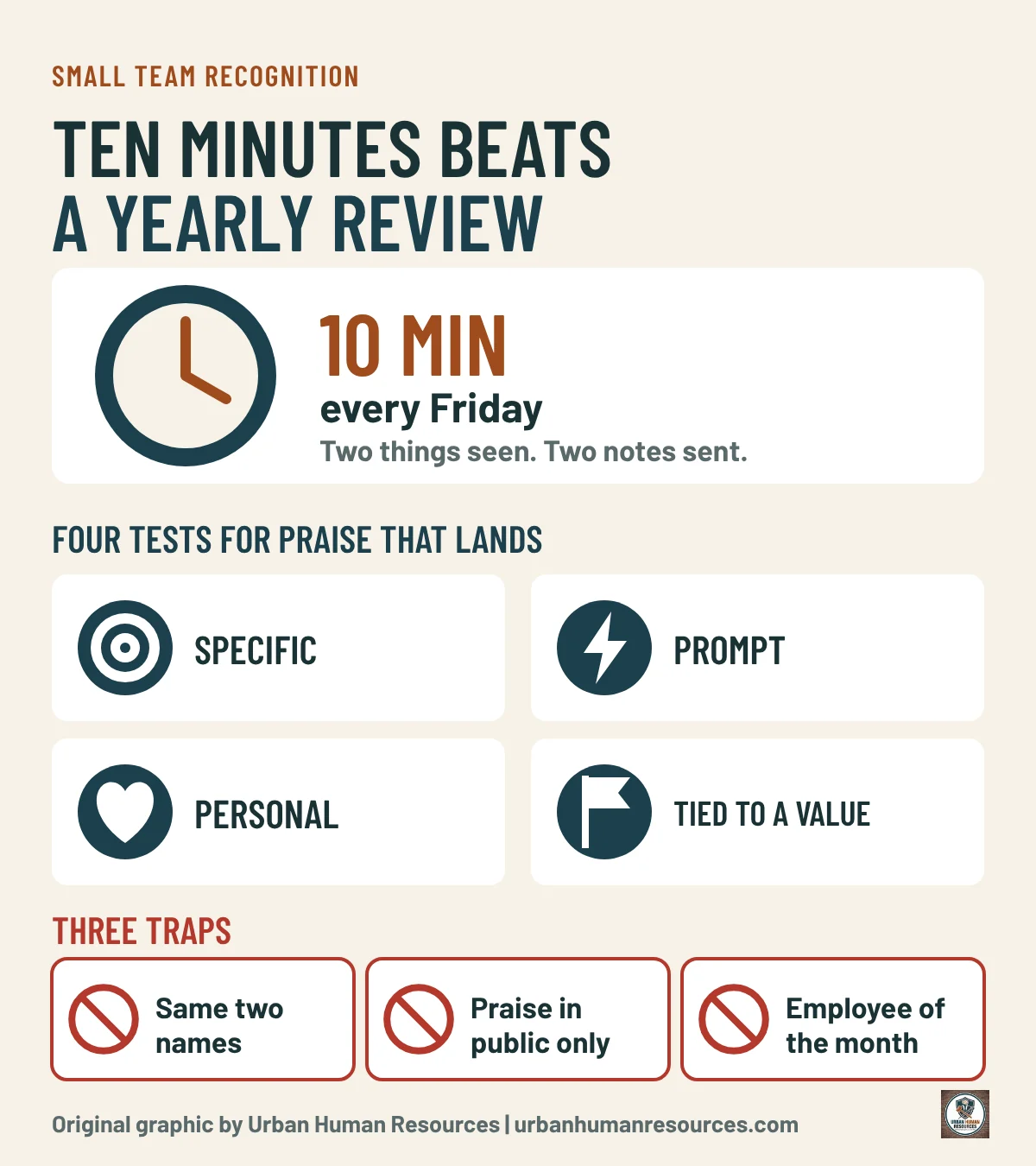
Recognition works when it is specific, prompt, personal and tied to something the business values. Block ten minutes every Friday to name two things you saw this week and send each person a note with the exact action and why it mattered. Skip cash and gift cards until you check the tax and overtime rules, because they are treated as wages. An HR advisor can set up the routine and the rules with you.
Recognition works when it is specific, prompt, personal and tied to something the business values. Block ten minutes every Friday to name two things you saw this week and send each person a note with the exact action and why it mattered. Skip cash and gift cards until you check the tax and overtime rules, because both are treated as wages. If your team does good work and nobody says so, I help small employers set up the routine and the rules, so appreciation stops depending on the owner’s memory.
I am Mac Malbrough. I hold a J.D. and an MS-HRM, I am not an attorney, and I help owners and managers build habits that people feel. This is general information, not legal advice, and the examples are hypotheticals.
Why does good work go unrecognized?
Nobody decides to withhold appreciation. The owner is closing a sale, the manager is covering a shift, and the thing that deserved a thank you happened on Tuesday and was gone by Wednesday. By the time the annual review comes around, nobody remembers it.
Small teams are exposed to this more than large ones, because there is no recognition platform, no awards committee and often no HR person. What exists is the owner’s attention, and attention is the scarcest thing in the business. The routine below is designed to need almost none of it.
What is the ten-minute Friday routine?
On Fridays, set a ten-minute block. Think back over the week and write down two things you saw someone do that you want repeated. Then send each person a short note, in the channel you already use, that says three things: what they did, what it made possible and what you want more of.
Here is a hypothetical. “Maya, when you re-checked the delivery window before confirming with the customer, we avoided a missed appointment. That kind of care is what keeps this client. Thank you.” It takes two minutes and it is precise enough that Maya knows exactly what to repeat.
Original graphic by Urban Human Resources.
What are the four tests for praise that lands?
Before you send a note, run it past four tests. Is it specific, naming an action and not a trait? Is it prompt, sent within days, not months? Is it personal, written in the voice you would use face to face, and delivered in the format that person prefers, which may be private rather than public? Is it tied to a value, so the person learns what the business wants more of?
If a note fails any test, rewrite it. “Great job this quarter” fails all four. It is pleasant, and it teaches nothing.
What are the three traps?
The first trap is the same two names every time. Recognition drifts toward the loudest people and the ones whose work is easiest to see, so the steady colleague who prevents problems is never named. Keep a simple tally for a quarter and look at who is missing.
The second trap is public praise for people who dislike it. Some people light up in front of the team, and others dread it. Ask once how each person likes to be thanked, and write it down.
The third trap is a ranking. Employee of the month sounds festive and quietly tells everyone else that they lost. Recognizing a behavior, not a person’s rank, keeps it open to the whole team.
When does a gift card become a payroll issue?
This is the part owners rarely check. The IRS treats cash and cash equivalents, including gift cards, as taxable wages to the employee, and it does not treat them as small gifts that can be ignored, whatever the amount (Publication 15-B). That means withholding and payroll tax apply.
Bonuses can also reach your overtime math. Under federal rules, a nondiscretionary bonus, one that is promised in advance or tied to a goal, is part of the regular rate of pay used to compute overtime for non-exempt employees (29 C.F.R. Section 778.211), and California applies the same principle. So an attendance bonus announced in January can change what you owe the hourly team in March. A thank-you note costs nothing and creates no wage question. A cash program needs a check first.
How does recognition work for remote or shift teams?
The routine travels well, because it asks for text and not a room. For a remote team, send the note in the direct message, and give the public mention in the team channel only to people who have said they like it. For shift teams, the risk is that the people on the nights and weekends rarely see the owner. Add a standing line to the Friday block: who worked a shift I did not see this week, and what did I hear about it?
Recognition should reach every shift and every location. If the person who opens the store at six every morning never appears in your notes, the tally will show it, and you can fix it.
How do you know it is working?
Watch for behavior, not applause. Do the recognized actions show up more often? Do people begin to thank each other without prompting? In your one-on-ones, do people mention a note you sent? Those are slow, honest signs. If you run a short pulse survey, add one question: “I know when my work is valued here.” A change in that single answer tells you more than a count of notes sent.
Where does an HR advisor fit?
An advisor helps you set up the routine, write the guardrails once and keep it running when the owner gets busy. In my fractional HR and advisory work, that includes setting the tally, drafting the rules for any cash or gift program and checking them against payroll before the first payout. The first conversation is a free consult.
McKinley holds a J.D. but is not a licensed attorney. Articles here are general information, not legal advice. For your specific situation, talk with an employment attorney.
Your best people leave because the next title does not exist. A career lattice offers growth sideways and deeper, not only up. Three skill levels per role, planned lateral moves, a pay…
If one person holds payroll, benefits renewals and the I-9s in their head, a resignation or a sick week becomes a legal deadline. A five-column task inventory, the three-week test, a documentation…
Small employers pile up HR tools and renew them on autopilot. A one-afternoon audit lists every tool, owner, seat and renewal date, flags overlap and unused seats, and adds a vendor question…