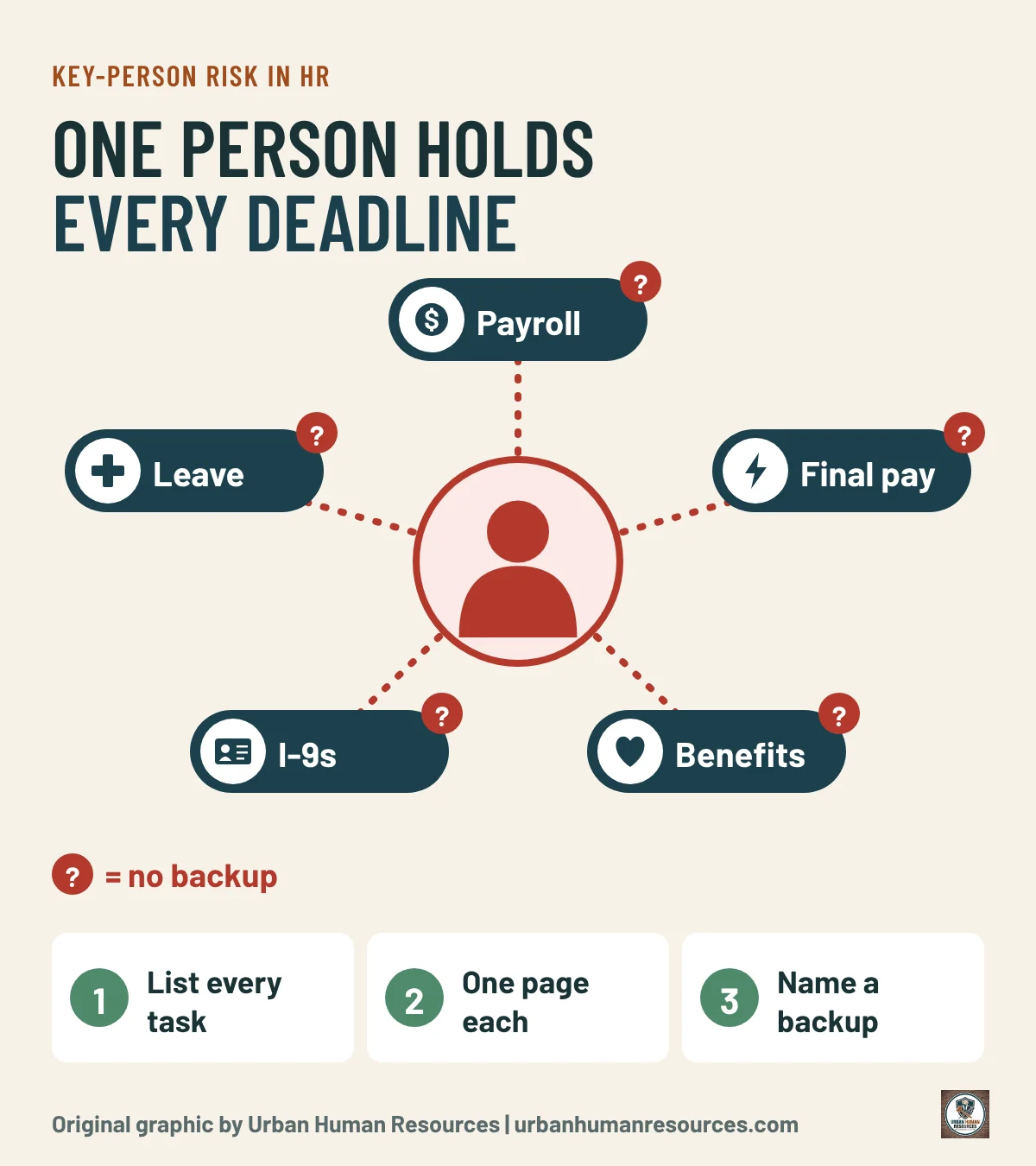
List every recurring HR and payroll task, who does it, who backs them up, where it is written down and what a missed deadline costs. Run the three-week test: if that person were out for three weeks, what breaks first? Then write a one-page procedure for each task and name a backup who has done it once. Final pay and payroll tax deadlines do not pause for absences. An HR advisor can serve as the backup while you build the system.
List every recurring HR and payroll task, who does it, who backs them up, where it is written down and what a missed deadline costs. Then run the three-week test: if that person were out for three weeks, what breaks first? Write a one-page procedure for each task and name a backup who has done it once. Final pay and payroll tax deadlines do not pause for an absence. If one person in your company holds payroll, benefits renewals and the I-9s in their head, an HR advisor can serve as the backup while you build the system.
I am Mac Malbrough. I hold a J.D. and an MS-HRM, I am not an attorney, and I help small employers make HR survive a bad week. This is general information, not legal advice, and the examples are hypotheticals.
What is key-person risk in HR?
It is the risk that a task stops when one person does. In small companies it is common and invisible, because it looks like reliability. Dana has run payroll for six years. She knows which employee gets a stipend, when the benefits broker needs the census and which login belongs to which vendor. Nothing has ever gone wrong, which is why nobody has asked what happens when Dana is out.
The risk is not about Dana. It is about a system that has no second copy. A resignation, a medical leave, a family emergency or a long vacation puts every one of those tasks in the air at once.
Which deadlines do not wait for an absence?
Some HR tasks tolerate a delay and some do not. The second kind are the ones that make key-person risk expensive.
Final pay is the clearest. In California, wages are due immediately when an employee is discharged, and within 72 hours when an employee quits without notice (Labor Code Sections 201 and 202). Late final pay can trigger waiting time penalties of up to 30 days of wages (Section 203). If the one person who knows how to cut a final check is unreachable, the penalty clock does not care. My post on final paycheck waiting time penalties shows the math.
Payroll tax deposits and filings run on the IRS and state schedules, and the IRS publishes the deposit rules for employment taxes. A missed deposit date creates penalties and notices that someone must untangle. Benefits renewals carry a similar cliff, when the carrier’s deadline passes and the plan year starts without the changes you wanted.
Original graphic by Urban Human Resources.
How do you build the task inventory?
Open a spreadsheet and make five columns: task, owner, backup, where it is written down and what a miss costs. Fill the rows with everything that recurs: the payroll run, final pay, the benefits census, the I-9s, leave tracking, the compliance posters, the annual training, the login list for every system.
The empty cells tell you where the risk is. A task with an owner and no backup is a single point of failure. A task with a backup who has never done it is the same, with better paperwork.
What is the three-week test?
Pick the person who holds the most rows and ask: if they were out for three weeks starting tomorrow, what breaks first, what breaks second and who would find out? Write the answers down. Most owners are surprised by the first answer and uncomfortable with the second.
Then rank the tasks by deadline cost. Pay and tax deadlines go first, benefits next and anything that can wait a week goes last. That ranking is your documentation order.
How do you document and cross-train without a project?
Run a documentation sprint, one task at a time. Ask the owner to do the task while a colleague watches and writes the steps, and the screenshots, in a one-page procedure. It takes an hour per task, not a month, and the procedure is tested the moment the colleague follows it once.
Then rotate. Each quarter the backup runs the task while the owner watches. The owner learns where the procedure is wrong, and the backup learns the task for real. Add a rule for access: credentials live in a password manager with at least two named administrators, and vendor accounts use company emails, not a personal one.
What does a good one-page procedure contain?
A procedure is good when a competent colleague can follow it on a bad day. It holds six things: the purpose and the deadline, the system and where to log in, the steps in order with screenshots, the inputs you need from other people, the checks that tell you it worked and who to call if it did not. Write in plain sentences. If a step relies on a habit, such as “Dana always checks the new hires first,” write the habit down.
Store the procedures in one shared place with two people who can edit them. A procedure that lives on one person’s laptop has the same risk it was meant to remove.
What if the person is out on a protected leave?
This is where the system pays off. A person on a medical, family or other protected leave should not be fielding calls about where the files are. The backup runs the task from the procedure, and if the procedure has a gap, you fix it without contacting the person on leave. If a leave is coming, use the weeks before it for the handover, with the owner and backup running one cycle together.
Where does an HR advisor fit?
An advisor is the backup that does not have to be on your payroll full time. In my fractional HR work, I can hold the procedures, run the inventory with you and step in during an absence for the HR tasks that cannot wait. The first conversation is a free consult. For the broader build order, read what HR functions to build first.
The Succession Planner for Critical Roles highlights roles where one person holds the knowledge, and my RACI Matrix Kit turns the inventory into a clear answer to the question of who does what and who backs it up.
What should you do this week?
Build the five-column inventory for payroll, final pay, benefits, I-9s and leave tracking.
Run the three-week test on the person who holds the most rows.
Write one procedure, starting with final pay.
Name a backup for every task with a deadline cost, and have them do it once.
Move every system login into a shared password manager with two administrators.
If you want a backup while you build, book a free consult through my fractional HR page, or join one of the free live sessions.
McKinley holds a J.D. but is not a licensed attorney. Articles here are general information, not legal advice. For your specific situation, talk with an employment attorney.
Your best people leave because the next title does not exist. A career lattice offers growth sideways and deeper, not only up. Three skill levels per role, planned lateral moves, a pay…
Your people want to be seen and you are too busy to notice out loud. A ten-minute weekly routine, four tests for praise that lands, three traps, and the pay and tax…
Small employers pile up HR tools and renew them on autopilot. A one-afternoon audit lists every tool, owner, seat and renewal date, flags overlap and unused seats, and adds a vendor question…