Training fails to change behavior when nothing in the job asks for the new skill. Fix the weeks after the session, not the session. Name one behavior before the course, use it on real work within 48 hours, have the manager check one example in week two, and review at day 30 whether to keep, fix or drop the training. That follow-through is what an HR advisor builds with you, so the budget you already spend starts paying back.
Training fails to change behavior when nothing in the job asks for the new skill. The fix is in the weeks after the session, not in the session itself. Name one behavior before the course, use it on real work within 48 hours, have the manager check one example in week two, and review at day 30 whether to keep, fix or drop the training. If you have paid for courses, workshops or a learning platform and Monday still looks the same, that follow-through is what I build with small employers as an HR advisor, so the budget you already spend starts paying back.
I am Mac Malbrough. I hold a J.D. and an MS-HRM, I am not an attorney, and I help small employers connect training to the work. This is general information, not legal advice, and the examples are hypotheticals, not results from any client.
Why does training fail to change what people do on Monday?
Picture a six-person operations team that sends everyone to a two-hour course on giving feedback. People leave with notes, a certificate and good intentions. By the next Monday, the notes are in a drawer, the manager has a full calendar and the team does what it always did. Nobody was careless. The course ended and the job took over.
That is the pattern I see most often, and it is a design problem, not a people problem. Most employers measure training by whether it happened: who attended, who finished, how many hours were logged. Those numbers tell you the money was spent. They tell you nothing about whether anyone works differently, and the difference is the whole reason you bought the training.
The cost is quiet. You pay for the course, you pay for the time away from work, and then you pay again when the same problem returns and someone suggests another course. A small employer cannot afford that loop twice.
What does the research say makes training transfer?
Researchers call the use of training on the job transfer. In 1988, Timothy Baldwin and Kevin Ford organized decades of studies into three groups of factors: the trainee’s own characteristics, the design of the training, and the work environment the person returns to. Transfer, in their framing, has two parts: using the skill in a new situation and still using it later. Blume, Ford, Baldwin and Huang later gathered the quantitative studies into a meta-analysis and kept the same three groups in view.
For a small employer the practical reading is simple. You control two of the three groups more than you think. You can design the training around one behavior, and you can shape the work environment by what the manager asks about afterward. You have the least control over the trainee’s personality, and it matters least to the plan below.
What is the follow-through plan?
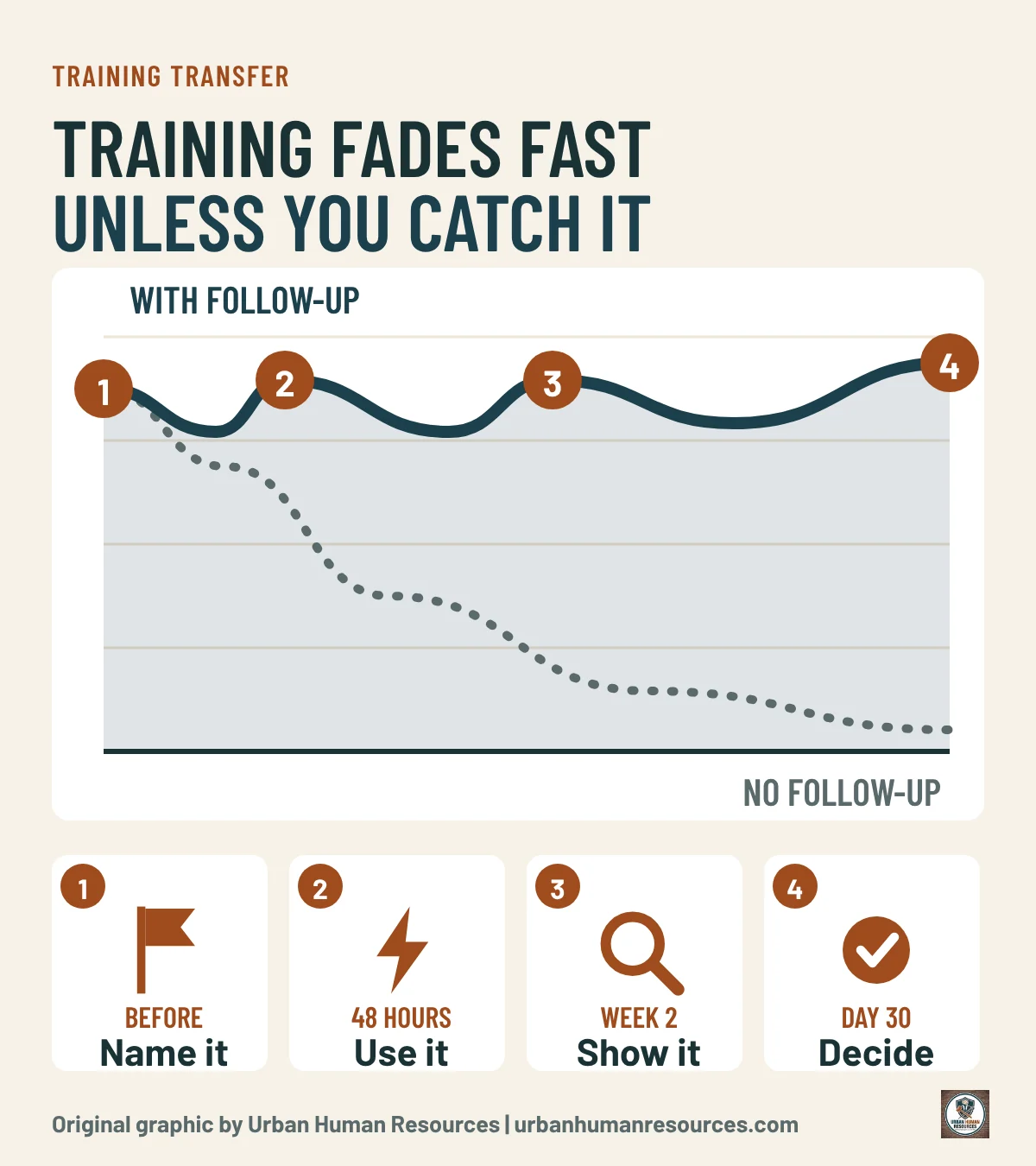
The plan has four steps, and each one attaches a small action to the training so the job keeps pulling the skill forward. The graphic below shows the sequence.
Before: the manager and the employee name the one behavior the training should change, in a sentence anyone could observe.
Within 48 hours: the employee uses it once on real work, however small.
Week two: the manager asks for one example and talks it through for ten minutes.
Day 30: the manager and HR review whether the behavior shows up, then keep, fix or drop the training.
Original graphic by Urban Human Resources.
What does the manager do at each step?
The manager carries most of this plan, which is why it works in a company with no learning department. At the start, the manager writes the target behavior with the employee. “Be better at feedback” is not a behavior. “Give one piece of specific feedback in each weekly one-on-one” is.
Within 48 hours, the manager clears a small opening for the first use. Training dies when the first chance to apply it is three weeks away, so the manager picks a real task this week that calls for it. In week two, the question is short and specific: “Show me one time you used it.” Ten minutes of talking through a real example does more than another hour of content.
At day 30, the manager looks for evidence in the work, not in a survey. Did the feedback appear in the one-on-ones? Did the error rate on the process change? Evidence can be small, and it should be something you can see.
How do you tell whether it worked?
Donald Kirkpatrick’s four levels of evaluation are a useful frame here: reaction, learning, behavior and results. Most employers stop at the first level with a happy-sheet survey. The plan above pushes you to level three, behavior, because the day-30 review looks at what the person actually does. I covered the models small employers can use in six HR models and when each fits.
Three questions make the day-30 review work. Is the behavior visible in the work? Is anything in the job blocking it, such as a tool, a policy or a manager who contradicts it? Would we pay for this training again? Answer honestly and you will drop some courses, which is a good outcome. The money goes to the training that changes behavior.
What do training records have to do with California law?
California’s Labor Code Section 1198.5 lets current and former employees inspect and copy personnel records that relate to their performance. Senate Bill 513, effective January 1, 2026, added education and training records to that list. Employers that keep training records need them to show the employee’s name, the training provider, the date and length of the training, the core competencies covered and any certification or qualification earned.
The request clock is 30 calendar days, and a missed deadline carries a $750 penalty that the employee or the Labor Commissioner can recover. So the follow-through plan doubles as record hygiene: each training you run leaves one clean record and one dated note about what changed. If you are considering a repayment agreement for training costs, read my guide to California stay-or-pay and training repayment first, because the rules there are strict.
What does this look like in a ten-person company?
Here is a hypothetical. A ten-person service company sends its two supervisors to a half-day course on running short team huddles. Before the course, the owner and the supervisors agree on the target: each supervisor holds a five-minute huddle at the start of every shift and names one priority. That is the behavior, and it is something anyone walking by could see.
On the first shift after the course, one supervisor runs the huddle and the other forgets. In week two, the owner asks each for one example. The first talks it through and adjusts. The second admits it did not happen, and the real reason comes out: the shift starts with a delivery that cannot wait. That is information the course could never have given you. The fix is a ten-minute change to the schedule, not another course.
What if the manager is the obstacle?
Sometimes the work environment contradicts the training. A course teaches delegation and the manager keeps taking tasks back. A workshop teaches written documentation and the team is praised for speed alone. When the day-30 review finds a blocker, name it plainly and treat it as the real finding. Training cannot outrun a manager who rewards the old behavior, and the honest response is to coach the manager first.
Where does an HR advisor fit?
You can run this plan yourself, and many small employers do. An advisor helps in three places. First, picking which training deserves the plan, since you cannot follow through on everything. Second, writing the target behaviors so managers are not inventing them alone. Third, running the day-30 reviews with you the first few times so the habit forms.
In my fractional HR and HR advisory work, this is a standard part of building a learning routine. The scope and monthly rates are on my fractional HR page, and the first conversation is a free consult.
McKinley holds a J.D. but is not a licensed attorney. Articles here are general information, not legal advice. For your specific situation, talk with an employment attorney.
Data current as of November 2026. Sources are linked where each figure appears.
This article is general information, not legal advice. Laws change and every situation is different; for advice on yours, talk with an employment attorney.
Most small-business managers were promoted for doing the work, not for developing people. A coaching routine and a 6-month learning plan that fit inside a busy week.
A RACI matrix kit, a skills gap workbook, a development plan kit and a training needs workbook, built for 10 to 150 person organizations. What problem each one solves, how it works…
Pay and perks get the budget, but the person someone reports to shapes whether they stay. What Gallup and exit interview data say, the five manager habits that matter most, and how…