Published November 6, 2026. Last updated November 11, 2026.
Short answer
Teach managers one coaching routine, a weekly one-on-one built on three questions, and pair it with a learning plan that names two skills per person each half-year. Coaching works when it is short, regular and tied to real work. A manager who coaches 20 minutes a week for six months changes more than one who attends a two-day course.
Teach managers one coaching routine, a weekly one-on-one built on three questions, and pair it with a learning plan that names two skills per person each half-year. Coaching works when it is short, regular and tied to real work. A manager who coaches 20 minutes a week for six months changes more than one who attends a two-day course.
I am Mac Malbrough. I hold a J.D. and an MS-HRM, I am not an attorney, and I coach managers and owners who are good at their craft and were never taught how to develop other people. This is general information, and the scripts below are examples I wrote, not transcripts from a client.
Why do managers fall back on telling instead of coaching?
Because telling is faster in the moment and it is how most people were managed. A new supervisor has been the best server, the best technician or the fastest packer. When someone on the team struggles, the supervisor takes over the task, shows how it is done and moves on. The task gets finished and nothing changes. The next week the same problem returns.
Coaching asks the manager to slow down for a minute and help the employee find the move themselves. It feels slower, and it is, for the first few weeks. Then the employee starts solving the next problem without being asked, and the manager gets time back. That trade is the whole business case for coaching, and small teams feel it fast because every hour of a supervisor’s time is scarce.
What is a coaching routine a busy manager can actually keep?
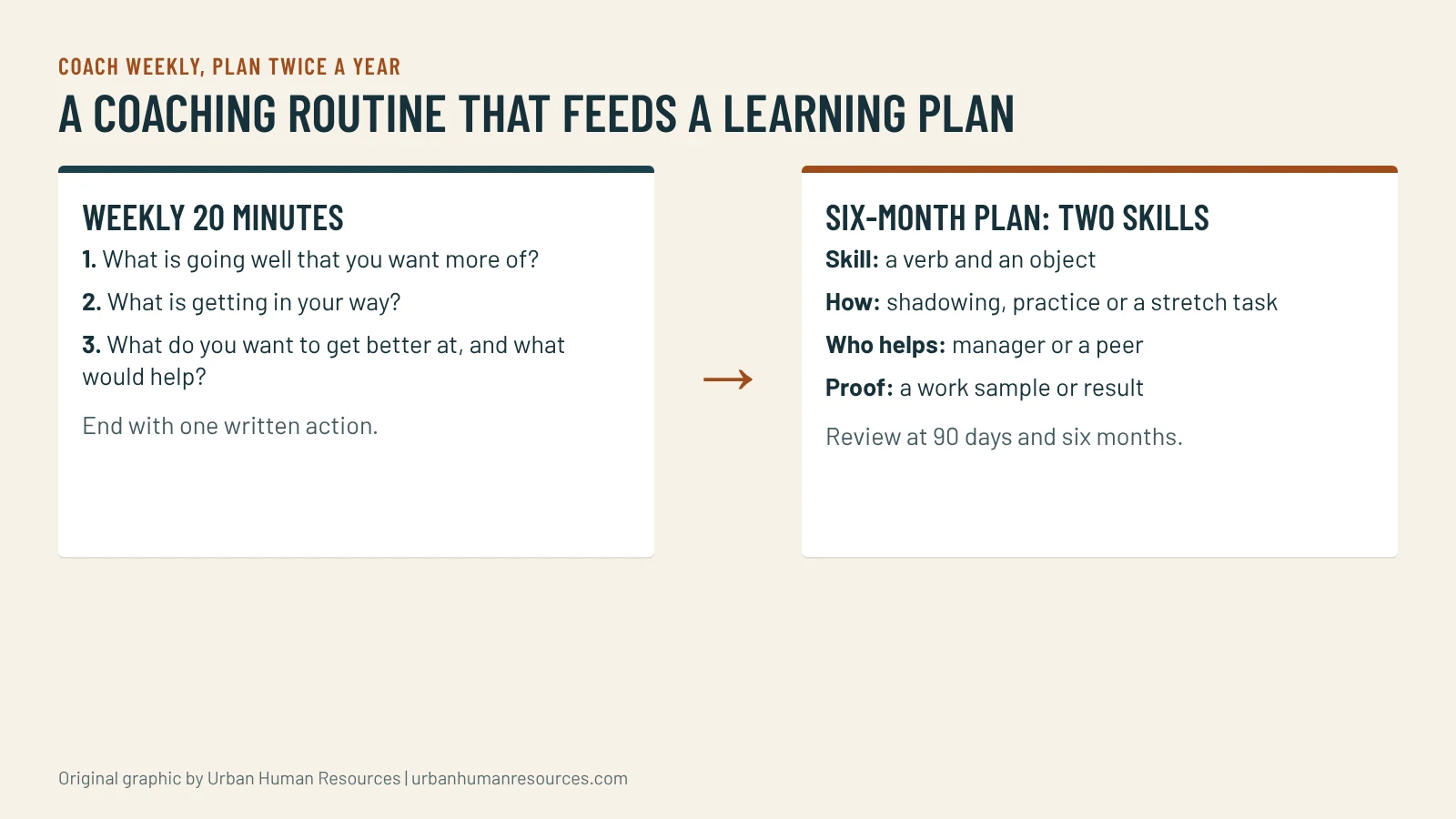
A weekly 20-minute one-on-one with the same three questions every time. Consistency matters more than cleverness, because the employee learns what to expect and arrives with something to say.
“What is going well that you want more of?” This builds on strengths and gives the manager information about what motivates the person.
“What is getting in your way?” This surfaces obstacles the manager may be able to remove: a tool, a handoff, a conflict, a schedule.
“What is one thing you want to get better at, and what would help?” This starts the development conversation and ties it to the person’s own goal.
The manager’s job in the conversation is to ask, listen and keep notes, and to speak last. Then each meeting ends with one agreed action, written down, that someone will do before the next one. A manager who runs this routine with five people spends under two hours a week. It is a cheap investment, and it is the same routine that makes a stay interview easy later, because the employee already talks to the manager about what matters.
What does coaching sound like in a real moment?
Take a hypothetical example. An employee’s work has errors that keep coming back. The telling response is “you need to double check your work.” The coaching response sounds like this:
“Walk me through how you did this one. Where did the numbers come from? Where could a mistake sneak in? What would you check if you had two more minutes? What do you want to try next time?”
Each question asks the employee to think, and the manager learns whether the problem is skill, time pressure, unclear instructions or a bad tool. That diagnosis changes the fix. If it is a tool, coaching the person will not help. If it is a skill, a short practice session will. If the same pattern continues after real coaching, you may be moving toward a performance conversation, covered in performance improvement plans in California. The coaching notes become part of a fair record, because they show the employee was told what was expected and given help.
How do you keep coaching from turning into therapy or favoritism?
Three guardrails. Keep the conversation about work, goals and obstacles on the job. If an employee raises a personal crisis, listen, thank them and point to the benefits or resources you offer, without probing. And give every direct report the same cadence and the same questions, so the quality of coaching does not depend on who the manager likes. Uneven coaching creates uneven development, and uneven development shows up later as uneven promotion and pay, which is a fairness problem and sometimes a legal one.
If a conversation surfaces something that sounds like a complaint of harassment, discrimination, a safety hazard or a wage issue, the manager does not coach it. They stop, thank the person and escalate to the owner or HR the same day. Put that rule in the manager playbook so no one has to decide on the spot.
How do you build a six-month learning plan?
Keep it to one page per person and two skills per half-year. More than two and nothing gets done. Pick the skills with the employee, using three inputs: what the job will demand in the next year, what the person wants to grow into and what the manager sees getting in the way.
The skill, in a verb and an object, such as “run the end-of-day close” or “handle a customer complaint without escalating.”
How the person will learn it: shadowing, a short course, practice with feedback or a stretch task.
Who will help, whether the manager or a peer who already has the skill.
How you will both know it worked, by a work sample, an observed task or a result on the job.
Original graphic by Urban Human Resources.
Review the plan at the 90-day mark and again at six months. Skills that were learned get a new one. Skills that stalled get a conversation about why: time, support or fit. A plan that is never reviewed is a wish list.
What if you cannot afford training programs?
Most development does not come from programs. It comes from assignments, feedback and peers. A stretch task with a check-in teaches more than a webinar. A peer who is strong at something can teach it in a 30-minute session. A manager who gives specific feedback within a day of the work does more than a course taken in a month. Spend the money where it adds something you cannot do in-house, such as teaching your managers how to coach or a specialized certification the job requires.
Look for changes you can see without a survey. Fewer repeat errors on the same task. Employees raising problems earlier. More tasks finished without the manager stepping in. Lower early exits and unplanned absence in the teams that run the routine. These show up in the numbers on the one-page HR dashboard, so you can compare coached teams to the rest over a few quarters. Be honest about what the comparison can show. Teams differ in many ways, so treat the result as a clue, not proof.
What if a manager resists coaching?
Some managers hear “coaching” as a criticism of how they already work, or as extra paperwork. Start with the pain they feel: the repeated errors, the interruptions, the person who never takes initiative. Show how the routine reduces that pain. Offer to sit in on the first two conversations and give feedback afterward, using the same three questions on the manager that they use on their team. People adopt a practice faster when they have felt it work on themselves.
Be clear about what is optional and what is not. The routine itself, the notes and the escalation rule are required. The style is theirs. A quiet manager and a talkative one will sound different and can both coach well, as long as they ask, listen and agree on an action. If a manager still will not do it after real support, that is information about whether the person belongs in a supervisory role, and it deserves a direct conversation.
Choose one manager and start the weekly 20-minute routine with one direct report. Use the three questions, take notes and agree one action. Do it four weeks in a row before you add a second person. A small start that survives is better than a launch that collapses by week three.
If you want me to train your managers and set up the learning plans, my HR services for small businesses include manager coaching and development design. The performance review and PIP templates hold the forms you will use when the coaching notes need to turn into a formal record.
This article gives a method, not statistics. The scripts are examples I wrote. The performance process is covered, with its legal citations, on the page linked below.
McKinley holds a J.D. but is not a licensed attorney. Articles here are general information, not legal advice. For your specific situation, talk with an employment attorney.
Data current as of November 2026. Sources are linked where each figure appears.
This article is general information, not legal advice. Laws change and every situation is different; for advice on yours, talk with an employment attorney.
Pay and perks get the budget, but the person someone reports to shapes whether they stay. What Gallup and exit interview data say, the five manager habits that matter most, and how…
Exit interviews tell you why people left. Stay interviews tell you why they have not. Six questions, how to run the conversation, what to do with the answers, and how to pair…
A performance improvement plan can be a real second chance or exit paperwork. How to tell which, what to do in the first 48 hours, when to negotiate an exit, and how…