Does a small business need HR, and when?
October 2, 2026
No law requires an HR department. California still hands you HR duties with your first employee. What small businesses actually need at each size, what can be outsourced and what it costs.
By McKinley Malbrough III, J.D., MS-HRM
Published November 6, 2026. Last updated November 7, 2026.
Short answer
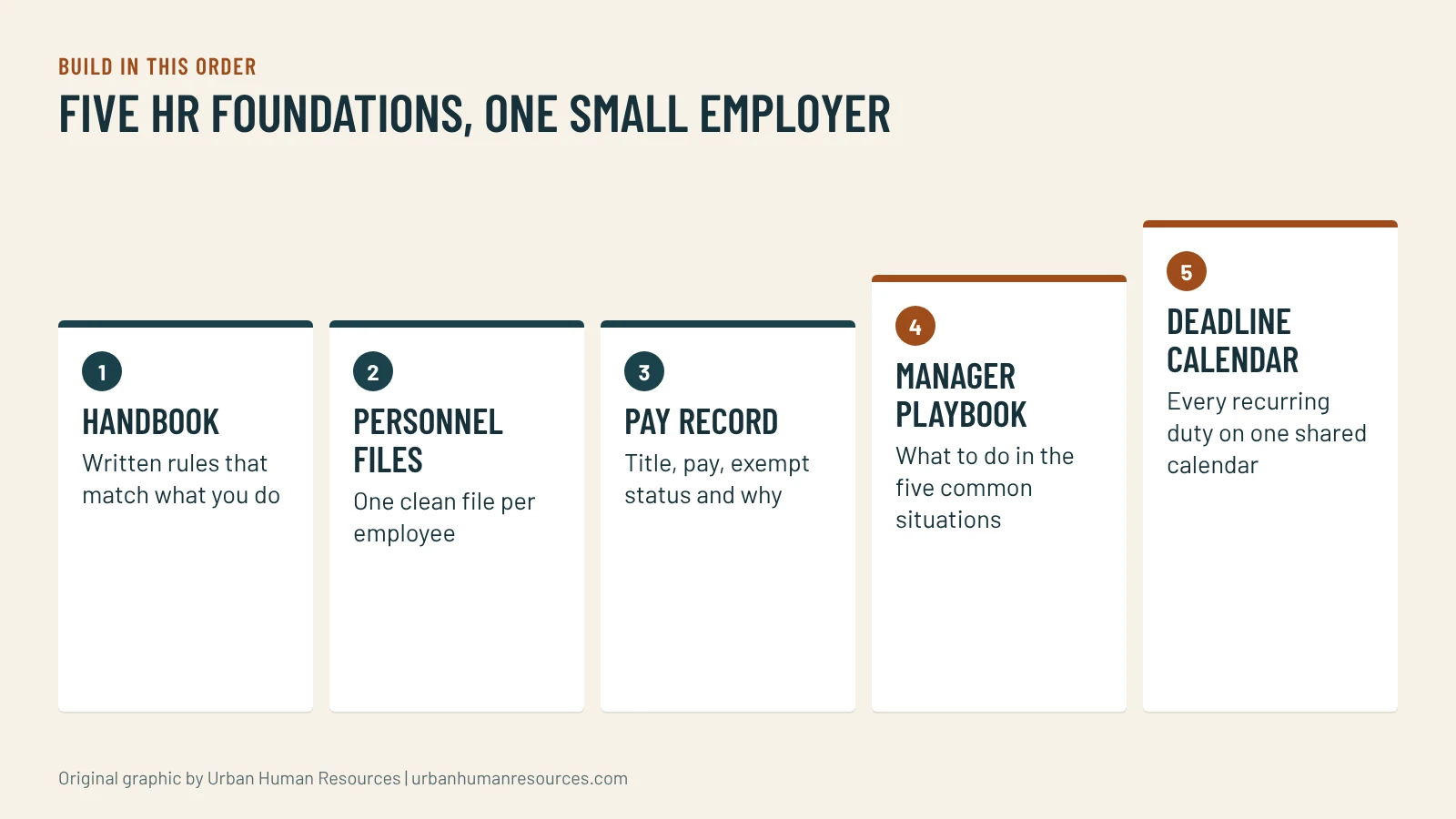
HR foundations are five written systems: a handbook, clean personnel files, a pay and classification record, a manager playbook and a calendar of deadlines. Without them, every decision depends on who remembers what. A small employer can put all five in place in about 30 days, working a few hours a week, and keep them current with a short monthly review.
HR foundations are five written systems: a handbook, clean personnel files, a pay and classification record, a manager playbook and a calendar of deadlines. Without them, every decision depends on who remembers what. A small employer can put all five in place in about 30 days, working a few hours a week, and keep them current with a short monthly review.
I am Mac Malbrough. I hold a J.D. and an MS-HRM, I am not an attorney, and I work with owners and managers who run lean teams in the Bay Area. This is the version of HR basics I give to a business that has grown past the founder’s memory and has no one whose job is people operations. It is general information, not legal advice.
Four things: the ability to hire without guessing, to pay people correctly, to manage people without improvising and to prove what happened when someone asks. Everything else in the field, from engagement surveys to leadership programs, sits on top of those four. When one of them is missing, the symptoms look like personality problems. A manager seems harsh, a new hire seems flaky, an employee seems entitled. Most of the time the real problem is that nobody wrote down what the rule was.
A small employer does not need a department to cover these four. It needs a short list of documents and habits that exist outside anyone’s head. That is what I mean by foundations. They are boring on purpose. They are also the reason a business can lose its office manager, or its owner can take a week off, and the people side keeps working.
The same five things break in nearly every small business I look at.

None of these is dramatic on its own. Together they produce what owners describe as “constant fires.” The fires are not random. They come from the gaps, and the gaps are predictable, which is good news, because predictable gaps can be closed.
Build in this order, because each one makes the next easier.
A handbook is the written version of the rules you already enforce, plus the rules the law requires you to state. It is not a legal shield by itself, and a handbook that describes practices you do not follow is worse than none, because it becomes evidence against you. Start with what California requires, covered in California employee handbook requirements, then add your own rules on schedule, conduct, time off and pay. My California employee handbook template gives you the structure, and you edit it to match your shop.
Keep one file per employee with the offer, the signed acknowledgments, the job description, the pay history and the performance notes. Keep medical information, immigration forms and investigation material in separate files, because mixing them creates access problems later. The test of a good file is simple: if a stranger read it in ten minutes, they could say what the person was hired to do, what they were paid, what they were told and how they performed.
One sheet with every employee, their title, their pay, their classification as exempt or non-exempt and the reason for that classification. This is the sheet that catches misclassification and pay drift before an outsider does. If you have not checked your exempt roles recently, the exempt vs non-exempt quick check takes a few minutes per role. For the pay side, setting a pay range for a new role shows how to build ranges that you can explain.
Two to four pages that tell a supervisor what to do in the situations that come up every month: a request for leave, a complaint, a late arrival pattern, a performance concern, a schedule change. The playbook does not replace judgment. It tells the manager where judgment ends and a call to the owner or to HR begins. When managers have no playbook, they either escalate everything or escalate nothing, and both are expensive.
A shared calendar with every recurring obligation: required trainings, posting updates, annual reviews, benefit enrollment windows and review dates for your own policies. The compliance calendar on this site is a starting point. The value is not the list. The value is that a missed date becomes visible to more than one person.
Most small-business managers were promoted because they were good at the work, and nobody taught them the part of the job that concerns people. Training does not have to be a course. A 45-minute monthly meeting with one scenario from the playbook, one question from the group and one decision about what the rule should say will do more than a day-long seminar that is forgotten by Friday.
Use the same three moves each time. Read a real situation, with names removed. Ask each manager what they would do and why. Then compare their answers to the playbook and fix whichever one is wrong, the answer or the playbook. Over a year, the playbook gets better and the managers get consistent. If you want a manager to practice the hardest conversations, hard conversation scripts for managers gives you the language.
Here is the plan I give small employers, sized for about three hours a week.

The handbook can run beside this work. Use the template, edit it against what you really do and issue it with a signed acknowledgment. Keep a dated copy of every version, because you will need to show which version was in force on a given day.
Three signs. You have no one who can own the foundations as part of their job. You are close to a headcount threshold where new rules apply, which California HR laws by headcount lays out. Or you have already had a complaint, a claim or a wage question and you are not sure the records would hold up. In those cases a review by someone who does this daily is cheaper than finding out the hard way.
My fractional HR service is built for this: I take over the foundations, set up the systems, train your managers and stay on for a set number of hours a month. For a one-time look, the HR compliance check-up reviews your documents against the California requirements and gives you a ranked list of fixes. If you are not sure whether you need HR at all, does a small business need HR answers that question.
Build the pay and classification record. It takes one afternoon and it tells you where your biggest exposure sits. Then book the first monthly review on your calendar before you close the sheet, so the habit exists before the motivation fades.
If you want a second set of eyes on the result, the HR compliance check-up is where I would start, and the handbook template gives you the document for the first foundation.
For all ten areas of HR and the order to build them, see the functions of HR and which to build first.
For templates that support these foundations, see the four new HR workbooks for roles, skills, development and training.
Related reading: six HR models and when each fits.
This article gives a method, not statistics. The legal points above link to pages on this site that cite their primary sources.
McKinley holds a J.D. but is not a licensed attorney. Articles here are general information, not legal advice. For your specific situation, talk with an employment attorney.
Data current as of November 2026. Sources are linked where each figure appears.
Share this article
This article is general information, not legal advice. Laws change and every situation is different; for advice on yours, talk with an employment attorney.
Related questions
October 2, 2026
No law requires an HR department. California still hands you HR duties with your first employee. What small businesses actually need at each size, what can be outsourced and what it costs.
October 26, 2026
A plain guide to the policies a California employer must put in writing, the ones that protect you when optional, and what to update before January 1, 2027.
September 14, 2026
A check-up reviews classification, pay, postings, leave, training, safety plans and files against the rules at your headcount, then ranks the fixes.