California employee handbook template
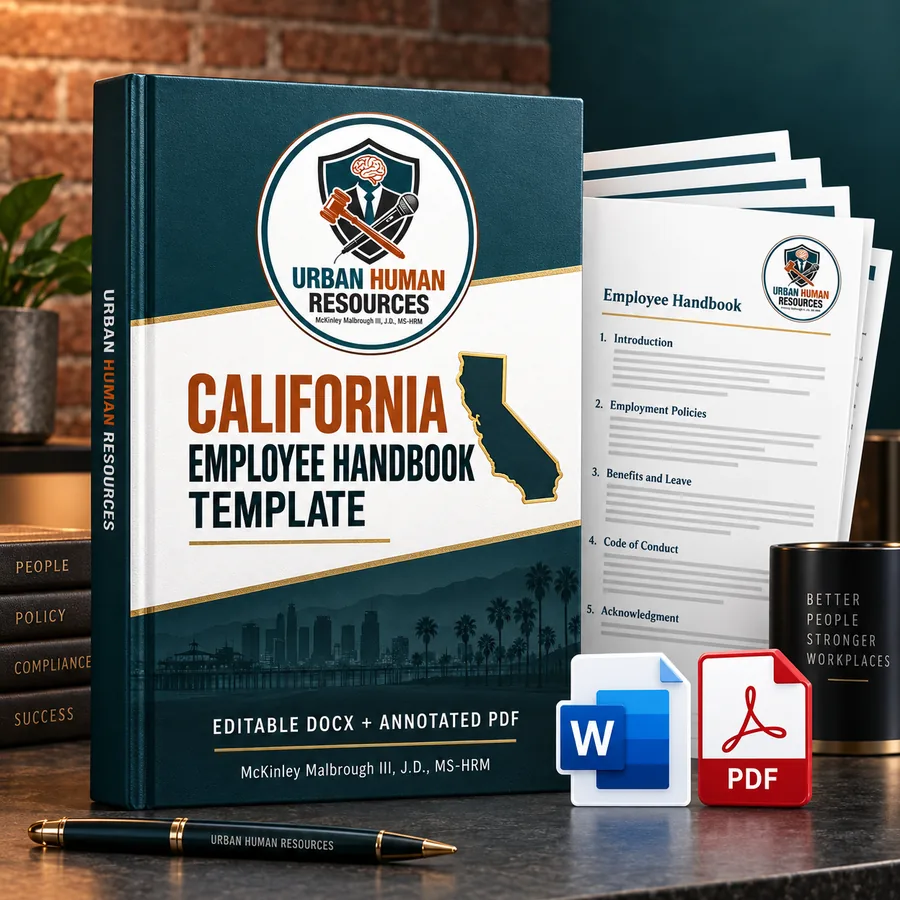
A full handbook in editable form, with the California-specific clauses written out and annotated…
$149 · See it
By McKinley Malbrough III, J.D., MS-HRM
Published September 18, 2026. Last updated September 26, 2026.
Short answer
At 5 employees, most of California’s discrimination, leave, and training rules begin; at 15, pay ranges in job postings; at 100, annual pay data reporting. A few rules apply from the very first employee, and each threshold adds more.
This is the hub for every California compliance question on Insights. Find your headcount, then follow the links to the rules that matter most at that size. Each rule names its statute so you can read the source yourself and bring it to your attorney.
A pay data report shows the same patterns an equal pay claim would. Organizations approaching 100 get more out of a range structure built on purpose than out of a first report that surprises them.
Count everyone on payroll, including part-time employees, and in several California rules, employees outside the state. Misclassified contractors count too, which is why a classification review and a headcount check belong together. The thresholds are not all measured the same way: some use employees in the current or preceding calendar year, some count only full-time equivalents, and Cal-WARN looks at a single establishment over the prior year. When you are close to a line, check the statute that defines it.
The pattern I see most is a company that crossed 5 employees a year ago and never scheduled harassment training, or crossed 15 and kept posting jobs without ranges. Nothing about the business felt different on the day it happened, so nothing changed. An urban organization of 10 to 150 people crosses three or four of these lines on the way up. Plan for the next one before you hire into it, and use a compliance check-up to confirm you caught up on the last one. To see where you stand today, the free California HR compliance checklist filters all 22 items to your exact headcount.
McKinley holds a J.D. but is not a licensed attorney. Articles here are general information, not legal advice. For your specific situation, talk with an employment attorney.
Data current as of September 2026. Sources are linked where each figure appears.
From the store
California employee handbook template
A full handbook in editable form, with the California-specific clauses written out and annotated…
$149 · See it
This article is general information, not legal advice. Laws change and every situation is different; for advice on yours, talk with an employment attorney.
Related questions
September 17, 2026
In California the worker is an employee unless you can prove all three parts of the ABC test. Part B is where most small organizations fail.
September 22, 2026
California requires harassment training at 5 employees. A qualified trainer, interactive e-learning or the state's free course can meet it. How to choose.
September 20, 2026
Under 15 employees you do not have to put a pay range in the posting, but you must give it to any applicant who asks. Here is how to count and what…