Published November 6, 2026. Last updated November 9, 2026.
Short answer
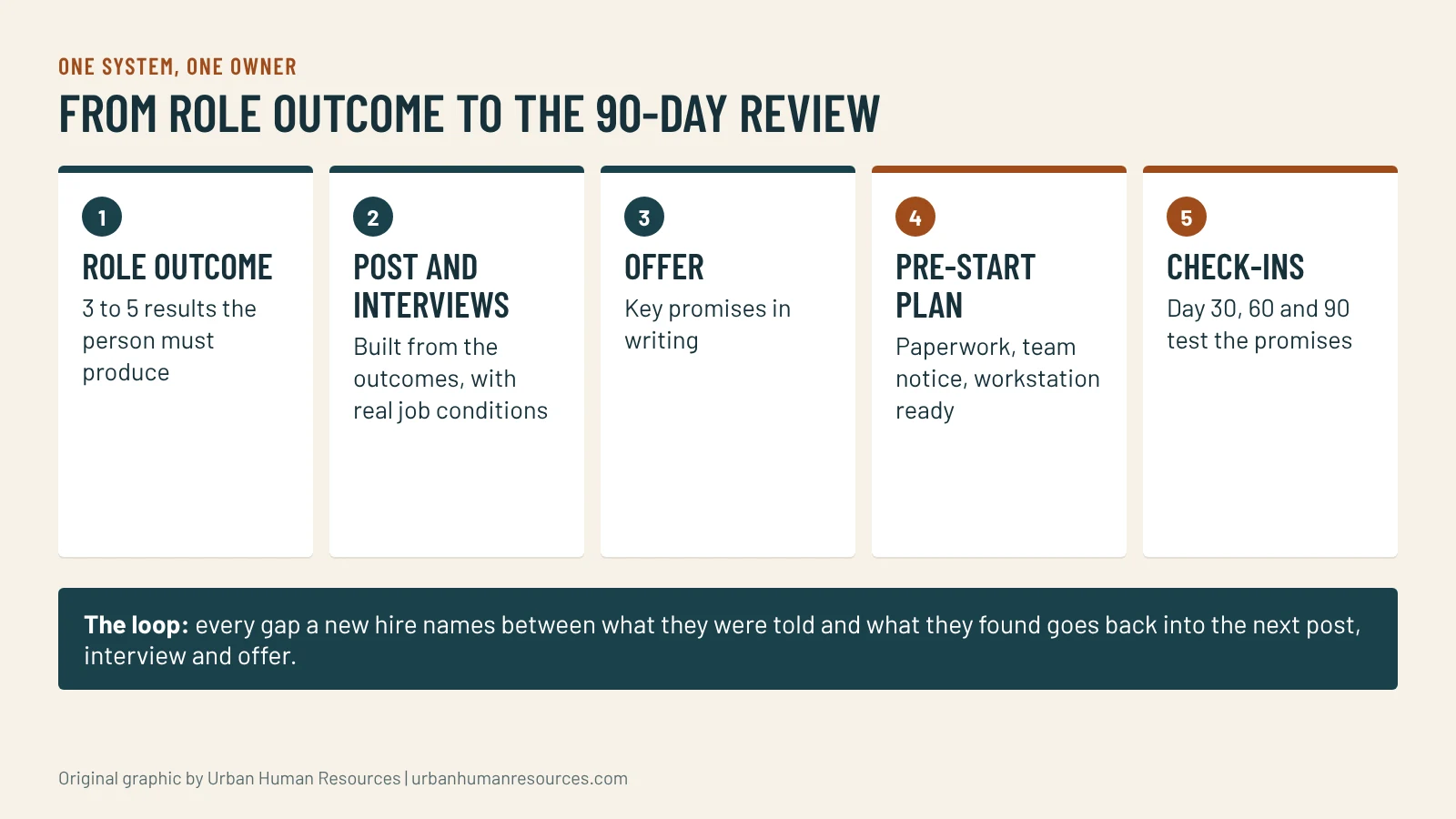
Treat hiring and onboarding as one system with one owner. The promises made in the job post and interviews become the checklist for the first week, and the first 90 days become the test of whether the hire worked. Connect the two with a written role outcome, a pre-start plan, a first-week schedule and three scheduled check-ins.
Treat hiring and onboarding as one system with one owner. The promises made in the job post and interviews become the checklist for the first week, and the first 90 days become the test of whether the hire worked. Connect the two with a written role outcome, a pre-start plan, a first-week schedule and three scheduled check-ins.
I am Mac Malbrough. I hold a J.D. and an MS-HRM, I am not an attorney, and I build hiring and onboarding systems for small employers who cannot afford a bad hire or a revolving door. This is general information, and the examples are hypotheticals I wrote to show the method, not client results.
Why do new hires leave so soon?
When someone quits in the first few months, the owner usually blames the person. In my experience the cause is often a gap between what the hire was told and what they found. The job post described a role with growth and the first month was spent filing. The interviewer said the team was close and the new hire ate lunch alone for two weeks. The offer promised a schedule and the first manager changed it in week three.
Each of those gaps starts in recruiting and surfaces in onboarding, which is why splitting the two between different people, or between nobody and a harried manager, makes the problem worse. Recruiting makes promises. Onboarding keeps or breaks them. If the same system owns both, you can check the promises against the reality before the new hire does.
What does a connected hiring and onboarding system look like?
A written role outcome: what this person must accomplish in the first year, in plain verbs.
A job post and interview plan built from that outcome, with the real conditions of the job stated.
An offer that repeats the key promises in writing.
A pre-start plan that makes the first day ready.
A 90-day schedule with check-ins that test the promises.
The point of the chain is traceability. When a new hire says “this is not what I expected,” you can open the file and see exactly where the expectation came from and whether the business kept its side. That turns a vague retention problem into a specific fix.
How do you hire for the job the person will actually do?
Start with the role outcome, not the last person’s title. Write three to five outcomes the person must produce, such as “closes the books by the fifth business day” or “keeps the delivery schedule with no more than two late routes a month.” Then write down the real conditions: the hours, the physical demands, the customers, the pace and the first manager. If the job involves difficult customers or a rough shift, say so. A candidate who walks away at that point has saved you a replacement cost.
What should the offer say so onboarding can keep it?
The offer is the hinge. Put the promises that matter in writing: the start date, the pay, the schedule, the location, the first manager and any training or review date you have committed to. Do not promise what you cannot control. “You will be considered for a review at six months” is safer than “you will get a raise at six months.” Then pass the offer to whoever runs onboarding, so the first-week plan is built from the promises and not from memory.
For the mechanics of closing an offer, how to build a recruiting process that gets offers accepted goes step by step. The part this article adds is the handoff: the moment the offer is accepted, the file moves to the onboarding owner with the role outcomes, the promises and the interview notes.
What happens between the accepted offer and the first day?
This is the quiet gap where candidates reconsider, and most small employers leave it empty. Fill it with a short pre-start plan:
Send the new-hire paperwork and the schedule for the first week at least several days before the start date.
Tell the team who is joining, what they will do and who will help them.
Prepare the workstation, access, tools, uniform or keys so nothing is missing on day one.
Have the manager send a short, human message that says what the first morning looks like.
None of this costs money. It tells the new hire that someone expected them, which is the feeling that carries people through a rough first month.
What should the first week and the first 90 days include?
The first week needs three things: a clear schedule, one named person to ask and a small win. The small win is a task the new hire can finish and be seen finishing, such as setting up their station or handling one customer with a coach nearby. It gives the person proof that they can do the job.
Then run three scheduled check-ins, each with a different question.
Day 30: Is the job what you were told? Compare it directly to the offer and the interview notes.
Day 60: What is getting in your way? Fix the obstacles that belong to the business.
Day 90: How are the outcomes going? Review the role outcomes and decide what the next 90 days hold.
My 30-60-90 onboarding kit gives you the check-in questions and the tracking sheet. Keep a note of every gap the new hire names between what they were told and what they found, because those notes are the feedback your hiring process needs.
How do you use the 90 days to improve hiring?
At the end of 90 days, ask the manager and the new hire the same two questions: what was accurate in how the job was described, and what was not. Collect the answers for every hire over a year and sort them. If three people say the schedule was different from what they were told, the problem is in your post or your first manager’s habits. If two say the job was harder than described, your post is too soft. Over time you rewrite the post, the interview and the offer from real feedback.
This is also where tracking pays off. Keep the four numbers from the recruiting article, time-to-fill, offer acceptance, the manager’s 90-day rating and one-year retention, and add one more: the number of promises in the offer that were kept by day 90. It is a rough measure, but it points straight at the gaps.
What if the hire is not working out by day 60?
Treat the 60-day mark as a decision point and not a surprise. If the person is struggling, ask first whether the cause sits with the job, the training or the fit. A manager who skipped the first-week plan, changed the schedule or never gave feedback has contributed to the result, and the fix may be to repair onboarding before judging the person. If you have done your part and the gap remains, write down what was expected, what you saw and what support you gave, and talk with the employee about it directly. If the pattern continues, a documented plan gives the person a fair chance and gives you a clean record. Performance improvement plans in California and the probationary period in California explain how to handle that stage carefully.
Whatever happens, close the loop with your hiring notes. If the person leaves, ask what the job was like compared with what they were told. If they stay, ask what helped. Either answer improves the next post, the next interview and the next offer, which is the reason to run hiring and onboarding as one system in the first place.
What should you do this week?
Pick the role you are most likely to hire next and write its three to five outcomes and its real conditions on one page. Then put the promise list beside it: everything the post, the interviews and the offer will say. That page becomes the spine of the system, and it takes less than an hour.
McKinley holds a J.D. but is not a licensed attorney. Articles here are general information, not legal advice. For your specific situation, talk with an employment attorney.
Data current as of November 2026. Sources are linked where each figure appears.
This article is general information, not legal advice. Laws change and every situation is different; for advice on yours, talk with an employment attorney.
The median job takes about 45 days to fill, and most companies never measure whether the hire worked. Recruiting best practices for small businesses, from the intake meeting to a signed offer.
Use at least two sourcing channels, score every candidate on the same job-related questions, and know where referrals help and where they quietly narrow your pool.
A missing pay range can lead to a complaint and penalties of $100 to $10,000 per violation. Here is what applicants can do and how employers fix it fast.