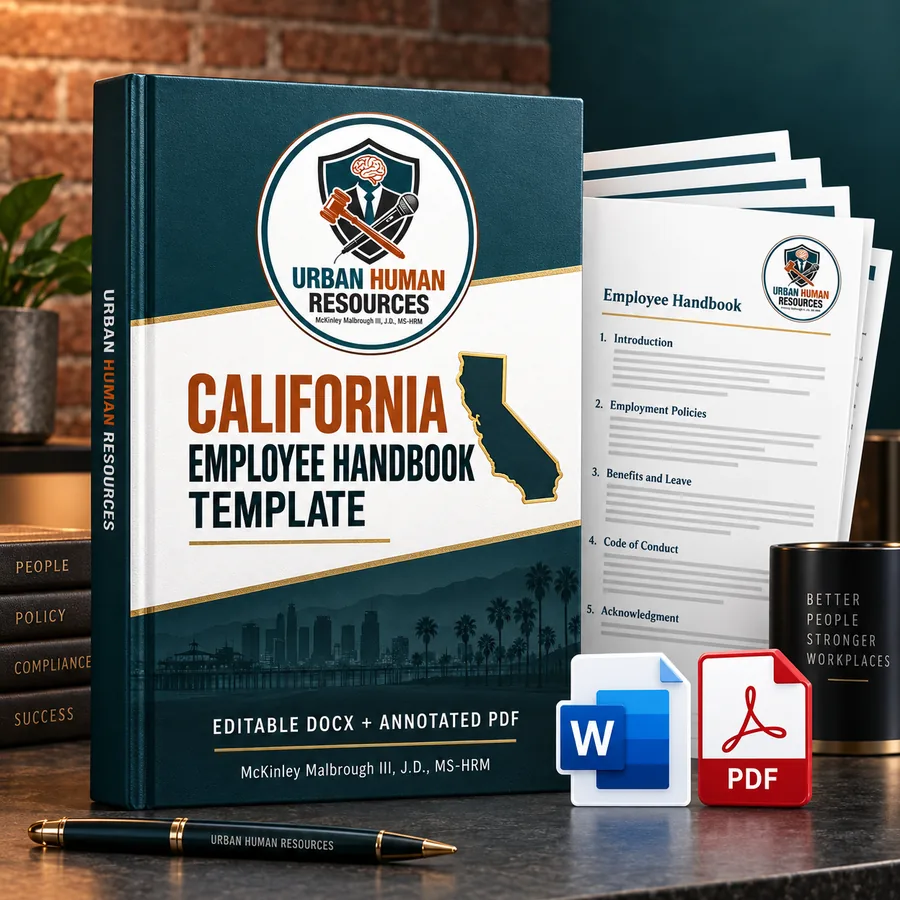
California employee handbook template
A full handbook in editable form, with the California-specific clauses written out and annotated…
$149 · See it
By McKinley Malbrough III, J.D., MS-HRM
Published September 24, 2026.
Short answer
Every California employer completes a Form I-9 for each new hire: the employee finishes Section 1 by the first day of work, and the employer examines documents and finishes Section 2 within three business days. California adds rules federal law does not: a posted notice within 72 hours of an immigration inspection notice, limits on E-Verify, and penalties for asking for more or different documents than the form allows. That process is HR work. Visa strategy, sponsorship and status questions belong with an immigration attorney.
The I-9 is an onboarding task, and I treat it like one. The new hire completes Section 1 by the first day of work for pay. Within three business days of that first day, the employer examines the documents the employee chose to present and completes Section 2. A Monday start has until Thursday. USCIS I-9 Central has the current form and the employer handbook.
The step small companies get wrong most often is the documents. The employee picks which acceptable documents to show. The employer does not ask for a specific one, does not ask for more than the form requires, and does not turn away a document that reasonably appears genuine. In California that mistake carries its own penalty, covered below.
Examining documents over video is allowed only for employers enrolled in E-Verify and in good standing, under the alternative procedure DHS made permanent in August 2023. Everyone else needs a person to examine the original documents in person, which can be an authorized representative near the new hire. If your team is remote and you are not in E-Verify, build that step into the offer timeline, not the first week.
Keep each I-9 for three years after the hire date or one year after employment ends, whichever is later. Work it out per person when someone leaves; the M-274 handbook walks through the math. I keep I-9s in their own file, separate from personnel records, so an inspection request never means handing over performance notes or medical leave paperwork.
A 72-hour notice. When an immigration agency gives notice that it will inspect I-9s, Labor Code 90.2 requires a posted notice to current employees within 72 hours, naming the agency, the date the notice arrived and the nature of the inspection. A second 72-hour clock starts when the results arrive: each affected employee gets a copy and a written explanation of what happens next. The Labor Commissioner publishes a template for the first notice. Have it saved before you need it.
No extra documents, no unrequired reverification. Labor Code 1019.1 makes it an unfair immigration-related practice to ask for more or different documents than federal law requires, to refuse documents that appear genuine, or to use the I-9 process against a worker. Reverifying someone when the law does not call for it falls under the same rules.
Limits on E-Verify. California does not require private employers to use E-Verify, and Labor Code 2814 bars using it to check current employees or applicants who have not received an offer, except where federal law requires it.
I handle the HR side of work authorization: the I-9 process, the onboarding timeline, the file, the notices, and training the person who sits across from the new hire on day one. I do not advise on visas, sponsorship, green cards, status questions or how to answer an agency on the legal merits. When a question turns on someone’s immigration status or the employer’s legal position in an inspection, the right call is an immigration attorney, and I will say so the moment we get there.
Pull ten I-9s and check three things: Section 2 inside three business days, no photocopied documents beyond what your policy covers for everyone, and a retention date you can find. Save the 90.2 notice template where your office manager can reach it. Then write down who examines documents for remote hires, because that answer decides whether your process is compliant before anyone asks. If you want the whole onboarding file checked at once, the compliance check-up covers I-9s alongside the rest of California’s hiring rules, and the free checklist is a good first pass.
McKinley holds a J.D. but is not a licensed attorney. Articles here are general information, not legal advice. For your specific situation, talk with an employment attorney.
Data current as of September 2026. Sources are linked where each figure appears.
From the store
California employee handbook template
A full handbook in editable form, with the California-specific clauses written out and annotated…
$149 · See it
This article is general information, not legal advice. Laws change and every situation is different; for advice on yours, talk with an employment attorney.
Related questions
September 18, 2026
At 5 employees most discrimination, leave and training rules begin; at 15, pay ranges in postings; at 100, pay data reporting. The full list by threshold.
September 22, 2026
A check-up reviews classification, pay, postings, leave, training, safety plans and files against the rules at your headcount, then ranks the fixes.
September 17, 2026
In California the worker is an employee unless you can prove all three parts of the ABC test. Part B is where most small organizations fail.