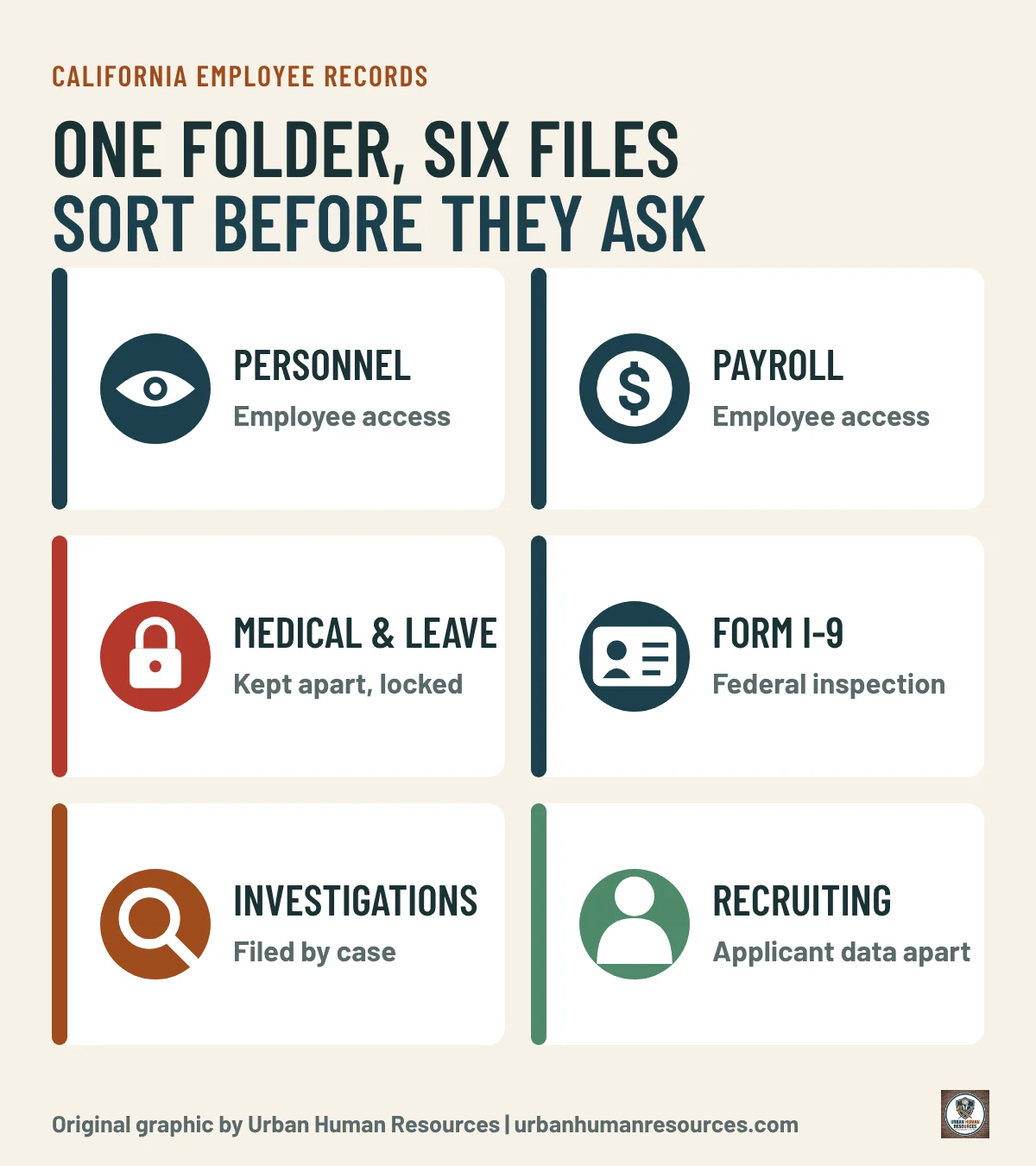
Keep six files per employee, not one: personnel, payroll, medical and leave, Form I-9, investigations, and recruiting data. A California employee can ask to inspect the personnel file, and you have 30 calendar days to respond, so the personnel file must hold only what belongs there. Mixed folders force you to over-share confidential records or miss ones you owe. An HR compliance check-up audits your files against these rules before a request arrives.
Keep six files per employee, not one: personnel, payroll, medical and leave, Form I-9, investigations, and recruiting data. A California employee can ask in writing to inspect the personnel file, and you have 30 calendar days to respond, so that file has to hold only what belongs there. A single mixed folder forces a bad choice when the request arrives: hand over confidential records you should have protected, or miss records you owe. If your files are one folder per person, an HR compliance check-up audits them against these rules before a request, a claim or an inspection arrives.
I am Mac Malbrough. I hold a J.D. and an MS-HRM, I am not an attorney, and this is general information, not legal advice. For a specific request or dispute, an employment attorney should review the facts. My offboarding checklist covers the records trail at separation. This post is about how the files are organized the whole time someone works for you.
Why does one folder per employee create risk?
The common setup is a drawer or a shared drive folder named for the employee. Inside sit the offer letter, the performance reviews, a doctor’s note, the I-9, a screenshot of a complaint and last year’s pay stubs. It feels organized because everything about the person is in one place.
That convenience is the problem. Different records have different audiences, different retention clocks and different confidentiality rules. Medical information has to be kept confidential and apart from the general file. An I-9 is a federal form with its own retention rule and its own inspection process. A complaint investigation carries sensitive information about other people. When all of it lives together, any one request, whether a personnel file demand from an employee, an I-9 audit or a litigation hold, pulls everything into the room.
What are the six files?
Here is the structure I recommend to small employers, and what each file holds. The graphic below puts it on one page.
Personnel file: offer letter, job descriptions, signed policy acknowledgments, performance reviews, discipline, commendations, training records and grievances that concern the employee.
Payroll file: wage statements, time records, deductions authorizations, pay rate changes, and the tax withholding forms.
Medical and leave file: leave certifications, accommodation requests and the interactive process notes, and any doctor’s notes.
Form I-9 file: the completed forms and any copies of documents you chose to keep, held for every employee in one place.
Investigation file: complaint intake, interview notes, evidence and the report, kept by case rather than by employee.
Recruiting file: the application, interview scorecards and, kept apart, any demographic information gathered for reporting.
Original graphic by Urban Human Resources.
What can an employee ask to see?
California Labor Code Section 1198.5 gives current and former employees, and their authorized representatives, the right to inspect and receive a copy of personnel records that relate to the employee’s performance or to any grievance concerning the employee. Since January 1, 2026, education and training records are part of that list under Senate Bill 513. I explain what a training record has to show in my post on why training does not stick.
The employer has 30 calendar days from a written request to make the records available, and the two sides can agree in writing to a later date no more than 35 days out. Copies can cost no more than the actual cost of reproduction. A missed deadline carries a $750 penalty that the employee or the Labor Commissioner can recover, and the employee can also sue for an order, costs and reasonable attorney’s fees. You must keep each employee’s records for at least three years after the employment ends.
The statute carves out a few categories: records relating to a criminal investigation, letters of reference, and certain pre-employment and promotional exam materials. You may check the requester’s identity and redact the names of nonsupervisory employees. A former employee can make one request a year.
Two nearby rights matter because they point at other files. Payroll records are covered by Labor Code Section 226(b), which gives current and former employees a right to inspect or copy them, with a 21-day deadline. And under Labor Code Section 432, an employee who signed an instrument relating to getting or keeping the job can ask for a copy of it.
What stays out of the personnel file?
Medical information stays out. The Americans with Disabilities Act requires employers to keep medical information about employees confidential and in a separate file, and California’s Confidentiality of Medical Information Act adds duties for employers who receive medical information. A doctor’s note, a leave certification or an accommodation record belongs in the medical and leave file with tight access, and the personnel file might hold only the approved leave dates.
The Form I-9 stays out as well. Federal rules require you to keep it for three years after the date of hire or one year after employment ends, whichever is later. Holding all I-9s in one place means that a federal inspection reviews those forms and not every employee’s performance history.
Investigation materials stay out, with one caution. Section 1198.5 excludes only records relating to a criminal investigation, so a workplace investigation file is not automatically shielded from a request. Keep the file separate by case, put the resulting discipline in the personnel file, and ask your attorney before you withhold anything that an employee requests.
Applicant demographic data stays out. The state’s fair employment regulations expect records about the sex, race or national origin of people hired to be stored separately from the main personnel file, so the people who decide on pay and promotion do not see it.
How long do you keep each file?
The clocks differ, which is another reason to separate them. Personnel records under Section 1198.5 run at least three years after termination. California’s fair employment rules, as amended by Senate Bill 807 effective January 1, 2022, call for preserving personnel and employment records for four years, and for keeping everything relevant until a filed complaint is fully resolved. In practice a small employer should treat four years after the personnel action or separation as the working floor, then hold longer when a claim is open.
Payroll and time records have their own periods under the wage orders and the Labor Code. The point of six files is that each one can carry its own destruction date, and a legal hold can freeze exactly the files it should. My HR Records Retention Cheat Sheet lists federal minimums by record type to start your schedule.
How do you audit your own files?
Pull three employees’ files, one current, one who left within the last year and one who left three years ago. For each, check four things. Is there any medical information in the personnel file? Is the I-9 in the folder with the performance reviews? Can you produce the file, redacted and complete, in a day if asked? Does anything have a retention date you cannot name?
If the answer to any of these is yes, you have found your first cleanup project. Most small employers find at least one in the first file they open.
Where does an HR advisor fit?
An advisor brings two things a busy owner rarely has: a checklist built on what auditors and plaintiffs’ lawyers look for, and the time to go through the files without interruption. My HR compliance check-up includes a records review, with findings ranked by risk and a plain-English list of fixes. If you also need performance documentation that holds up, my Performance Review and PIP Documentation Set gives managers a consistent format, which keeps the personnel file clean. For discipline, see my guide to performance improvement plans in California.
What should you do this week?
Write down the six files and where each lives today, paper or digital.
Move any medical notes and leave certifications out of the personnel files.
Gather every I-9 into one place, in order by employee.
Name the person who answers a records request and the form they use.
Pull three files and run the four-question audit above.
If you would rather have a second set of eyes on the whole system, book the HR compliance check-up, and the free live sessions cover compliance topics all year.
McKinley holds a J.D. but is not a licensed attorney. Articles here are general information, not legal advice. For your specific situation, talk with an employment attorney.
Data current as of November 2026. Sources are linked where each figure appears.
This article is general information, not legal advice. Laws change and every situation is different; for advice on yours, talk with an employment attorney.
When an employee leaves or is let go in California, the deadlines start immediately. A checklist for final pay, vested vacation, the written notice, release agreements, layoff notices and the records to…
How to fire an employee in California without inviting a wrongful termination claim: what employers need on termination day, and what employees should check before signing a severance agreement.
A performance improvement plan can be a real second chance or exit paperwork. How to tell which, what to do in the first 48 hours, when to negotiate an exit, and how…