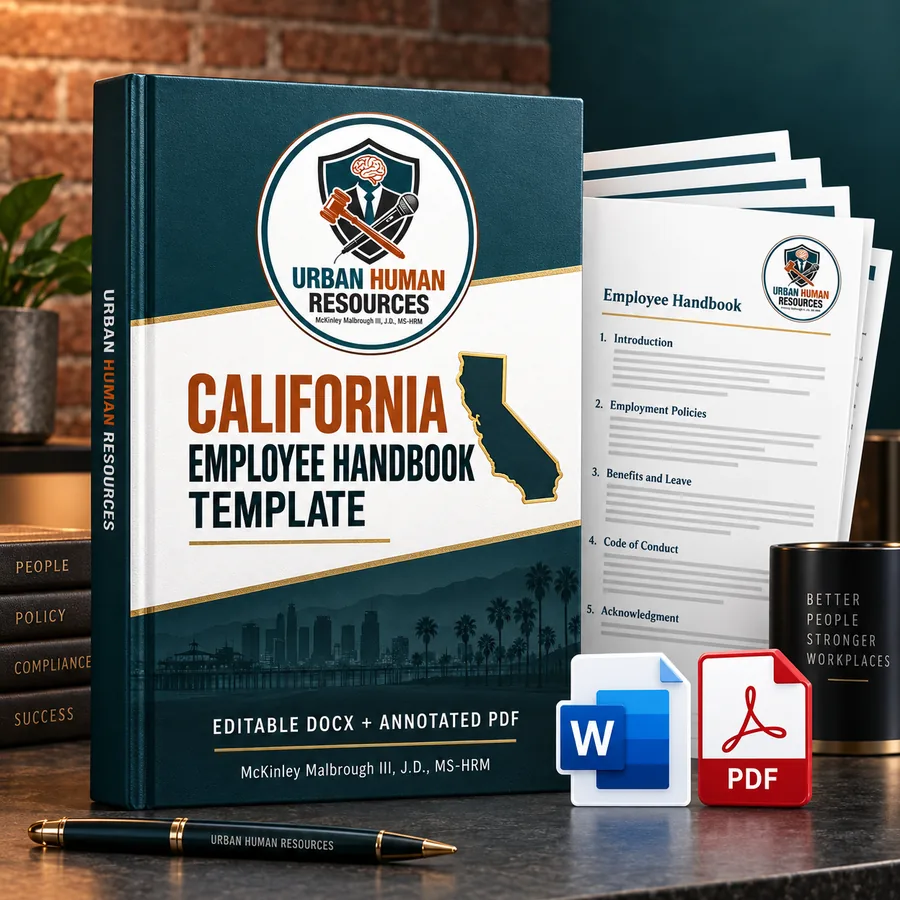
California employee handbook template
A full handbook in editable form, with the California-specific clauses written out and annotated…
$149 · See it
By McKinley Malbrough III, J.D., MS-HRM
Published September 26, 2026.
Short answer
California requires a 30-minute, duty-free meal period starting before the end of the fifth hour of work, a second one before the end of the tenth hour, and a paid 10-minute rest break for every four hours worked or major fraction. Each missed meal or rest period costs one extra hour of pay, and PAGA lets employees seek civil penalties for those violations on behalf of coworkers.
Meal and rest breaks generate more California wage claims than almost any other rule, and they land hardest on the businesses I work with most: restaurants, home care agencies and construction crews, where the work does not stop on schedule. The rules are specific. Knowing them exactly is cheaper than paying for them later.
An employee who works more than five hours gets an unpaid, duty-free meal period of at least 30 minutes that starts no later than the end of the fifth hour. More than ten hours requires a second meal period that starts before the end of the tenth hour (Labor Code 512). The first can be waived by mutual consent when the shift is six hours or less; the second, when the shift is twelve hours or less and the first was not waived.
Duty-free means the employee is relieved of all work and free to leave. The employer has to provide the break, not police it: an employee who chooses to keep working has not created a violation, but a schedule or a manager that makes the break impractical has.
A paid 10-minute rest break for every four hours worked or major fraction of four, placed near the middle of each work period where practical. In practice:
Rest breaks come from the Industrial Welfare Commission wage orders. Employees cannot be required to stay on call during them.
One additional hour of pay at the employee’s regular rate for each workday a meal period is missed, and another for each workday a rest break is missed (Labor Code 226.7). The regular rate includes nondiscretionary bonuses and incentives, not just the hourly wage. Up to two premium hours a day per employee adds up fast across a 20-person kitchen.
Records matter as much as the breaks. Meal periods have to be recorded, and a timecard that shows a late or short meal with no premium paid is the starting point for most claims. Rounding meal punches is not allowed.
The Private Attorneys General Act lets an employee sue for civil penalties for Labor Code violations on behalf of the state and other employees. The default penalty is $100 per employee per pay period, which is why a meal break problem that runs across a whole staff for a year becomes a large number.
The 2024 reforms (AB 2288 and SB 92, Labor Code 2699) changed the math for employers that act early:
Those steps are what a compliance check-up tests, and they are the difference between a 15% cap and full exposure. Premiums still owed at separation also belong in the final paycheck. The free California HR compliance checklist filters every rule to your headcount.
McKinley holds a J.D. but is not a licensed attorney. Articles here are general information, not legal advice. For your specific situation, talk with an employment attorney.
Data current as of September 2026. Sources are linked where each figure appears.
From the store
California employee handbook template
A full handbook in editable form, with the California-specific clauses written out and annotated…
$149 · See it
This article is general information, not legal advice. Laws change and every situation is different; for advice on yours, talk with an employment attorney.
Related questions
September 26, 2026
Fired employees are paid on the spot; quits get 72 hours or the last day. Miss it and the day's wages keep running for up to 30 days.
September 18, 2026
At 5 employees most discrimination, leave and training rules begin; at 15, pay ranges in postings; at 100, pay data reporting. The full list by threshold.
September 22, 2026
A check-up reviews classification, pay, postings, leave, training, safety plans and files against the rules at your headcount, then ranks the fixes.