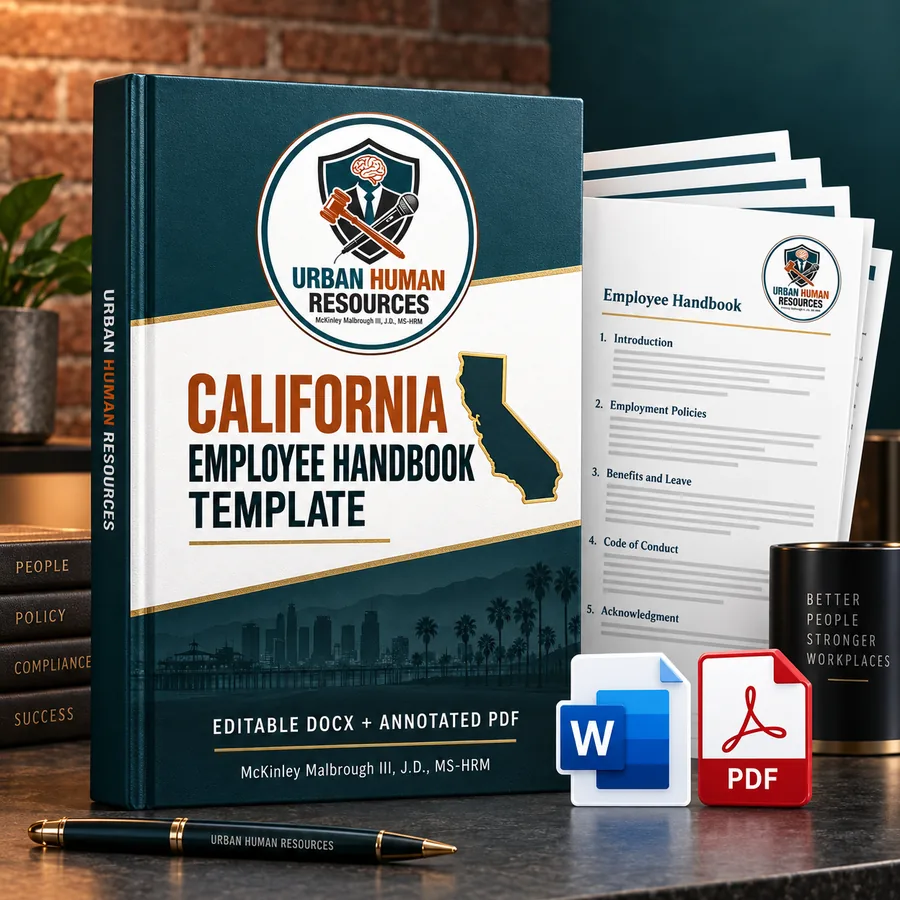
California employee handbook template
A full handbook in editable form, with the California-specific clauses written out and annotated…
$149 · See it
By McKinley Malbrough III, J.D., MS-HRM
Published September 26, 2026.

Short answer
No. California voids almost every contract that restrains someone from working in a lawful profession, trade or business, and since 2024 it is unlawful for an employer to include a noncompete in an employment contract or try to enforce one, wherever it was signed. The main exceptions involve the sale of a business or the dissolution of a partnership.
California has refused to enforce employee noncompetes for more than a century. What changed recently is that including one is now its own violation, and so is most “stay-or-pay” language. Employers still using old templates, and employees who signed one elsewhere, both need to know where things stand.
Every contract that restrains anyone from engaging in a lawful profession, trade or business is void to that extent (Business and Professions Code 16600). The exceptions are narrow: someone who sells the goodwill of a business, or a partner or member when a partnership or LLC dissolves, can agree not to compete in a defined area (Business and Professions Code 16601).
California courts treat most employee and customer non-solicitation clauses as restraints too. The safer ground for an employer is protecting trade secrets and confidential information directly, under the Uniform Trade Secrets Act, rather than trying to restrict who a former employee can call.
For contracts entered on or after January 1, 2026, an employer generally cannot require a worker to repay training costs, a sign-on bonus or another debt when employment ends (Business and Professions Code 16608, Labor Code 926). There are exceptions, including government loan forgiveness programs, approved apprenticeships, certain tuition agreements for a transferable credential offered separately from the employment contract, and certain discretionary sign-on payments that meet strict conditions. A violation can cost the greater of actual damages or $5,000 per worker. The law is not retroactive; agreements signed before 2026 are judged under the old rules.
Review offer letters and handbook language now. A compliance check-up includes this, and it matters at any size; see California HR laws by headcount.
If your offer letter or an old agreement contains a noncompete, it is void in California and should not stop you from taking a new job. Confidentiality still binds you: do not take client lists or files. When comparing two job offers, read the repayment terms as closely as the salary, and if one asks you to sign a noncompete, point to the law and ask for it to come out. Leaving on your own terms is covered in terminations and severance.
McKinley holds a J.D. but is not a licensed attorney. Articles here are general information, not legal advice. For your specific situation, talk with an employment attorney.
Data current as of September 2026. Sources are linked where each figure appears.
From the store
California employee handbook template
A full handbook in editable form, with the California-specific clauses written out and annotated…
$149 · See it
This article is general information, not legal advice. Laws change and every situation is different; for advice on yours, talk with an employment attorney.
Related questions
September 26, 2026
At-will does not mean undocumented. What employers need on termination day, and what employees should check before signing a severance agreement.
First-Generation Professionals
September 22, 2026
Put both offers into annual dollars: base, expected bonus, equity at a discount, retirement match and health costs. Then weigh the parts money misses.
September 18, 2026
At 5 employees most discrimination, leave and training rules begin; at 15, pay ranges in postings; at 100, pay data reporting. The full list by threshold.