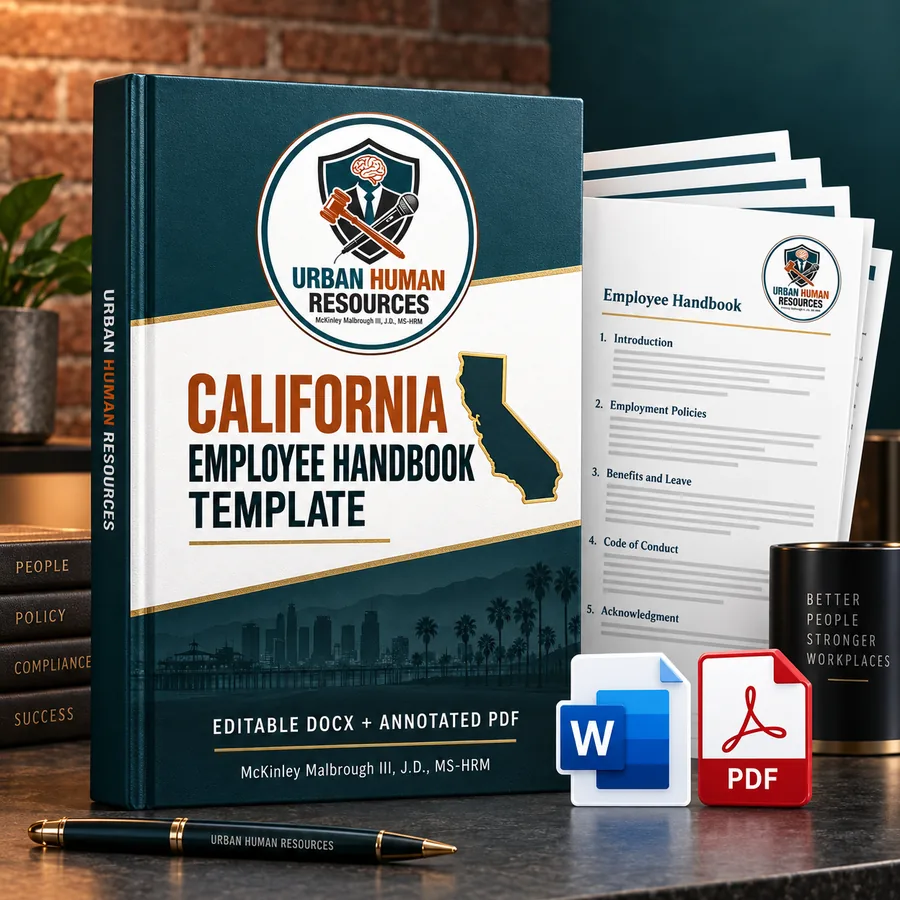
California employee handbook template
A full handbook in editable form, with the California-specific clauses written out and annotated…
$149 · See it
By McKinley Malbrough III, J.D., MS-HRM
Published September 22, 2026. Last updated September 25, 2026.
Short answer
Fractional HR for a Bay Area company of 10 to 150 people typically runs $5,000 to $10,000 a month for a senior HR lead working part of each week. Lighter advisory support runs $2,000 to $4,000 a month. A full-time HR manager in the San Francisco-Oakland area averaged $208,900 in wages in 2023 before benefits, which add roughly 43 cents for every wage dollar.
The Bureau of Labor Statistics Occupational Employment and Wage Statistics put the annual mean wage for HR managers in the San Francisco-Oakland-Fremont area at $208,900 in May 2023. HR specialists averaged $109,830.
Wages are not the whole cost. The BLS Employer Costs for Employee Compensation survey found private employers paid $32.36 an hour in wages and $13.79 in benefits in December 2025. That is about 43 cents in benefits for every dollar of wages. On a $208,900 salary, the fully loaded cost approaches $298,000 a year, or about $24,800 a month, before recruiting fees and software.
| Option | Typical monthly cost | Best fit |
|---|---|---|
| HR advisory | $2,000 to $4,000 | Someone internal runs HR day to day and needs a senior partner for the hard calls |
| Fractional HR | $5,000 to $10,000 | No one owns HR, and you need policies, hiring, pay and employee relations handled |
| Full-time HR manager | About $24,800 loaded | Headcount and hiring volume keep one senior person busy every week |
The difference between fractional HR and HR advisory is who does the work: fractional means the HR lead does it, advisory means your team does it with senior backup. Ranges vary with scope, headcount, how much is broken on day one and whether the work is ongoing or a defined project. A written quote after a scoping conversation is the standard.
If you hire several people a month, run a large hourly workforce, or handle employee relations issues daily, the volume usually justifies a full-time hire. Fractional HR can still build the system and help you recruit the person who will run it.
Most small employers bring in HR help after something goes wrong: a wage claim, a misclassified contractor, a termination that turned into a demand letter. At that point the fee covers cleanup instead of prevention. The cheapest time to build the system is before the first claim, when the fixes are policy updates and not settlements.
Start with a defined project. A compliance check-up shows what needs fixing and how much work it is, and the answer tells you whether you need a monthly lead or a one-time cleanup. Either way, you are paying for a list of fixes, not a guess.
McKinley holds a J.D. but is not a licensed attorney. Articles here are general information, not legal advice. For your specific situation, talk with an employment attorney.
Data current as of September 2026. Sources are linked where each figure appears.
From the store
California employee handbook template
A full handbook in editable form, with the California-specific clauses written out and annotated…
$149 · See it
This article is general information, not legal advice. Laws change and every situation is different; for advice on yours, talk with an employment attorney.
Related questions
September 22, 2026
Price the job before the person: define the level, pull three market sources, set the midpoint, and check it against the people you already pay.
September 22, 2026
A check-up reviews classification, pay, postings, leave, training, safety plans and files against the rules at your headcount, then ranks the fixes.
September 18, 2026
At 5 employees most discrimination, leave and training rules begin; at 15, pay ranges in postings; at 100, pay data reporting. The full list by threshold.